
About This Worksheet
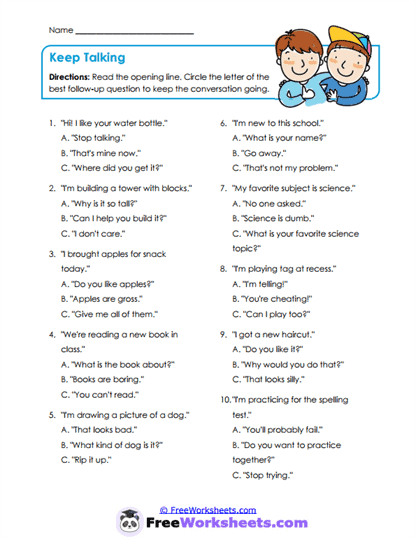
Keep Talking is a structured conversation-skills worksheet designed to help students recognize which responses continue a conversation and which ones shut it down. Starting a conversation is only the first step; sustaining it requires curiosity, active listening, and respectful follow-up. This worksheet presents opening lines such as “I like your water bottle” or “I’m building a tower with blocks,” followed by three possible responses. Students must determine which response keeps the interaction going in a positive and engaging way. The activity strengthens conversational flow, social awareness, and peer interaction skills across elementary and middle grade levels.
Rather than focusing only on politeness, this worksheet emphasizes conversational momentum. Students learn that questions, affirmations, and interest-based follow-ups tend to build connection, while dismissive or critical comments end communication. This supports both SEL development and practical speaking skills.
Curriculum and Grade Alignment
This worksheet aligns with Social Emotional Learning (SEL) competencies in relationship skills and social awareness. It supports Common Core Speaking and Listening standards (SL.1.1-SL.8.1), particularly skills related to collaborative conversations and building on others’ ideas. It also aligns with TEKS ELAR Speaking and Listening standards emphasizing appropriate responses and respectful discussion. Best suited for Grades 2-6, with flexibility for older intervention groups focusing on social communication.
Student Tasks
Students read each opening line carefully. They evaluate three possible responses and circle the one that best continues the conversation. Learners must think about tone, relevance, and curiosity. The task requires analyzing both content and intent. Students practice identifying responses that show interest, invite elaboration, or ask thoughtful questions.
Common Challenges and Misconceptions
Some students may choose responses that are neutral rather than truly engaging. Others may struggle to distinguish between humorous and dismissive remarks. Students with emerging social awareness may not immediately recognize how criticism or abrupt statements end conversations. Teacher modeling and group discussion improve comprehension.
Implementation Guidance
This worksheet works well during SEL lessons on friendship, peer communication, or classroom community building. Teachers can extend the activity through role-play, allowing students to practice both strong and weak responses. Small-group discussions encourage students to explain why one option is more effective. Parents may use the worksheet to practice conversational skills before social events.
Details and Features
The worksheet includes ten conversation starters with multiple-choice responses. The layout is clean and accessible for upper elementary learners. It supports both independent work and guided discussion. The format promotes real-life application of conversational skills.