
About This Worksheet
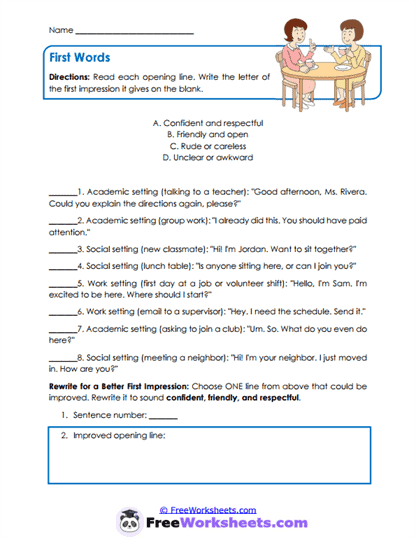
First Words is an advanced conversation analysis worksheet that focuses on first impressions created by opening lines. Starting a conversation sets the tone for the entire interaction. This worksheet presents different academic, social, and workplace scenarios and asks students to evaluate the impression each opening line gives.
Students categorize statements as confident and respectful, friendly and open, rude or careless, or unclear and awkward. This activity develops social judgment, tone awareness, and audience sensitivity. It is particularly valuable for older students preparing for academic discussions, interviews, leadership roles, and workplace interactions.
The worksheet emphasizes that word choice, politeness markers, and confidence influence how others respond. Students move beyond identifying “good” or “bad” statements and instead analyze nuance in tone and setting.
Curriculum and Grade Alignment
This worksheet aligns with upper-level SEL competencies in self-awareness, relationship skills, and responsible decision-making. It supports Common Core SL.6.1-SL.12.1 standards related to adapting speech to context and demonstrating appropriate style. It also aligns with TEKS ELAR standards focused on effective oral communication in academic and professional settings. Best suited for Grades 6-12.
Student Tasks
Students read each opening line within its context (academic, social, or work setting). They select the letter that best describes the first impression the statement gives. In Part Two, students revise one weaker opening to make it confident, friendly, and respectful. This requires tone adjustment, audience awareness, and thoughtful language revision.
Common Challenges and Misconceptions
Students may struggle to distinguish between friendly and confident tones. Some may misidentify awkward phrasing as rude rather than unclear. Others may overlook how context changes interpretation. Class discussion improves depth of analysis.
Implementation Guidance
Teachers can use this worksheet during middle or high school advisory, career readiness lessons, or interview preparation units. Students may compare answers in pairs and explain reasoning. Role-play exercises can reinforce the impact of tone and posture. Counselors may use it to prepare students for presentations or interviews.
Details and Features
The worksheet includes multiple context-based conversation starters across social and professional settings. A revision section promotes applied practice. The structured layout supports analytical thinking and self-reflection. It is suitable for independent work or guided discussion.