
About This Worksheet
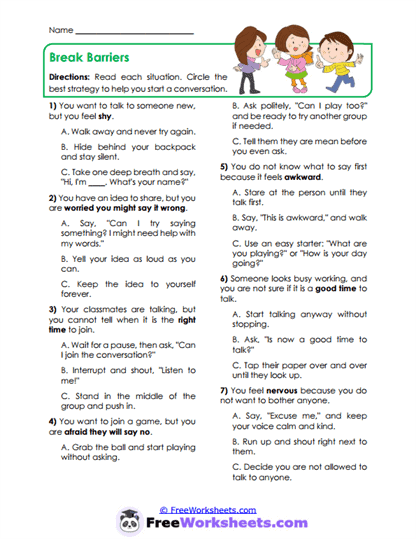
Break Barriers is a social communication worksheet designed to help students overcome hesitation when starting conversations. Many students understand what to say but struggle with when and how to say it-especially in situations involving fear of rejection, uncertainty, or social anxiety. This worksheet presents common social barriers such as worrying someone will say no, feeling awkward, or not knowing how to join a group. Students must choose the healthiest and most effective strategy for starting a conversation.
Rather than focusing only on politeness, this activity targets confidence, timing, and emotional regulation. It reinforces that respectful communication includes reading the room, using calm body language, and choosing supportive words. The worksheet promotes proactive social problem-solving and reduces avoidance behaviors.
Curriculum and Grade Alignment
This worksheet aligns strongly with Social Emotional Learning (SEL) competencies, particularly relationship skills, self-management, and responsible decision-making. It supports Common Core Speaking and Listening standards (SL.3.1-SL.12.1), emphasizing participation in collaborative discussions. It also aligns with TEKS ELAR standards that address appropriate speaking strategies and adapting communication to context. Best suited for Grades 4-10, with flexibility for upper elementary through high school SEL instruction.
Student Tasks
Students read each real-life social scenario carefully. They evaluate three possible responses and circle the one that represents the most respectful, confident, and appropriate strategy. Learners must analyze tone, timing, and social impact. The task requires perspective-taking and critical thinking. Students practice identifying responses that promote connection rather than avoidance or confrontation.
Common Challenges and Misconceptions
Students may select passive responses that avoid discomfort rather than building communication skills. Others may confuse assertiveness with aggression. Some learners may underestimate the importance of body language and calm delivery. Guided discussion after each scenario helps deepen understanding and prevent surface-level answers.
Implementation Guidance
This worksheet works well in upper elementary and middle school SEL lessons focused on friendship skills, group inclusion, and confidence-building. Teachers can extend the activity through role-play scenarios to practice voice tone and posture. Small-group discussion encourages students to explain their reasoning. School counselors may also use this resource in small social skills groups. Parents can use it to support children who struggle with initiating peer interactions.
Details and Features
The worksheet includes multiple social barrier scenarios with structured answer choices. The format supports quick evaluation while encouraging discussion. The layout is clear and student-friendly. It promotes practical, real-world communication strategies that students can immediately apply.