
About This Worksheet
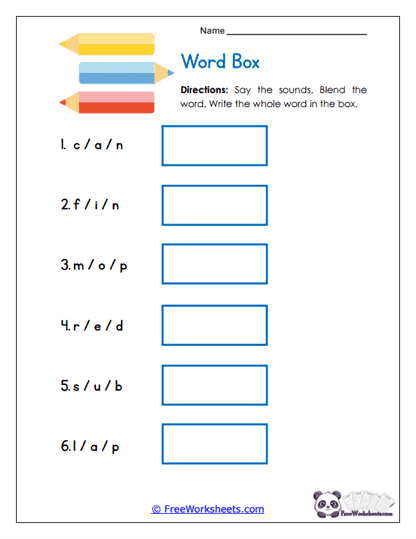
Word Box is a Kindergarten-level phonics worksheet focused on blending segmented phonemes and writing the complete word independently. Students are given segmented sounds (such as /c/ /a/ /n/) and must blend them together to form a recognizable CVC word before writing it in a designated box. This task strengthens decoding fluency and reinforces phoneme-to-grapheme correspondence. By requiring students to produce the word without picture support, the worksheet increases cognitive demand and encourages true phonemic processing.
This worksheet moves students beyond guided matching activities and into independent word production. Because students must rely entirely on sound blending rather than visual clues, it reinforces authentic decoding strategies. The repetition of CVC structures supports automaticity in short vowel recognition and consonant blending. Consistent exposure to this structure builds reading confidence and strengthens orthographic mapping in early learners.
Curriculum and Grade Alignment
Word Box aligns with Common Core RF.K.2.B and RF.K.3 standards related to blending sounds to read simple words. It also supports TEKS Kindergarten standards for phonological awareness and decoding simple CVC words. The worksheet reinforces foundational phonics instruction that prepares students for reading simple sentences and decodable texts. It is appropriate for mid-to-late Kindergarten literacy instruction.
This worksheet also supports early spelling development by encouraging correct phoneme representation. The act of writing the full blended word strengthens encoding skills alongside decoding practice. It provides a structured yet independent opportunity for demonstrating mastery of foundational reading standards.
Student Tasks
Students read each segmented phoneme set carefully. They blend the sounds together smoothly to form a word. Then, they write the complete word in the box provided. This process reinforces auditory discrimination and letter-sound application.
Students must rely on internal phonemic processing rather than picture prompts. The structured box format encourages neat handwriting and visual clarity. Each item strengthens decoding automaticity through repetition.
Common Challenges and Misconceptions
Some students may blend sounds too quickly and mishear the middle vowel. Others may guess based on the first consonant rather than fully blending all phonemes. Teachers should observe for accurate vowel pronunciation and smooth sound transitions. Encouraging finger tracking under each phoneme improves blending accuracy.
Students who struggle with short vowel differentiation may benefit from explicit vowel review before completing the worksheet. Modeling slow blending and repeating sounds aloud can reduce guessing behavior. Providing guided practice before independent completion improves overall performance.
Implementation Guidance
This worksheet works well as independent seatwork following explicit phonics instruction. It can also be used in literacy centers or small-group practice sessions. Teachers may encourage students to whisper-blend before writing to strengthen internal processing. Reviewing answers aloud afterward reinforces correct decoding.
The worksheet can also function as a formative assessment tool to determine readiness for reading decodable texts. Pairing this resource with guided reading practice enhances transfer of skills. Consistent implementation supports steady decoding growth.
Details and Features
Includes six segmented CVC phoneme sets. Provides individual writing boxes for each word. Focuses exclusively on blending accuracy and independent word production. Designed specifically for Kindergarten phonics mastery.