
About This Worksheet
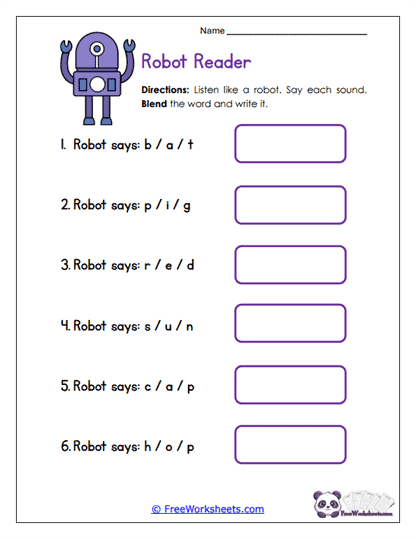
Robot Reader is a Kindergarten phonics worksheet designed to strengthen phoneme blending fluency through playful, structured repetition. Students “listen like a robot” by reading segmented phonemes one sound at a time before blending them into a complete CVC word. This engaging framing encourages careful articulation of each phoneme, preventing rushed or guessed blending. By incorporating a character theme (the robot), the worksheet increases motivation while reinforcing essential decoding skills.
This activity focuses on the cognitive shift from isolated sound recognition to smooth word formation. Students must hold each phoneme in working memory long enough to combine it accurately. The repetition of the robot blending structure promotes automaticity and confidence in early decoding. Because students write the blended word independently, they strengthen both decoding and encoding pathways simultaneously.
The worksheet also supports auditory discrimination by requiring precise vowel identification. Young learners often struggle most with medial vowel sounds, and this activity gives repeated, focused practice. The simplicity of the design allows students to concentrate fully on phonemic accuracy without visual distractions.
Curriculum and Grade Alignment
This worksheet aligns directly with Common Core Standard RF.K.2.B, which requires students to blend phonemes to form simple words. It also supports RF.K.3, focusing on applying letter-sound knowledge in decoding CVC words. In TEKS Kindergarten ELAR standards, it aligns with phonological awareness objectives that require blending spoken phonemes and recognizing sound-symbol relationships.
The structure is developmentally appropriate for early-to-mid Kindergarten students who have mastered basic letter sounds. It also serves as reinforcement practice for students needing additional decoding support. Because it integrates oral blending with written application, it supports both reading and early spelling benchmarks.
This worksheet is suitable for literacy centers, small-group instruction, intervention support, or formative assessment use. It provides measurable evidence of phonemic blending mastery.
Student Tasks
Students read each segmented sound set (for example, /b/ /a/ /t/) slowly and clearly. They blend the sounds together to form a whole word. Then, they write the blended word in the box provided.
The activity encourages deliberate pacing rather than guessing. Students must rely on accurate sound articulation to succeed. Writing the word reinforces correct phoneme sequencing and letter formation.
Common Challenges and Misconceptions
Students may attempt to guess the word after hearing only the first sound. Others may blend too quickly and distort the vowel sound. Teachers should monitor vowel clarity and encourage smooth transitions between phonemes.
Some learners may reverse letters while writing. Providing modeling and guided practice helps reduce these errors. Sound tapping strategies can improve blending accuracy and phonemic control.
Implementation Guidance
Use this worksheet after explicit blending instruction. Model one example as a whole class using exaggerated “robot” speech to demonstrate pacing. Encourage students to whisper-blend before writing.
This worksheet works especially well during phonics centers or intervention blocks. It can also serve as a quick decoding fluency check. Consistent use supports stronger word recognition and reading readiness.
Details and Features
Includes six segmented CVC blending items.
Provides structured writing boxes for each word.
Focuses exclusively on phoneme blending and decoding accuracy.
Engaging theme increases student motivation.