
About This Worksheet
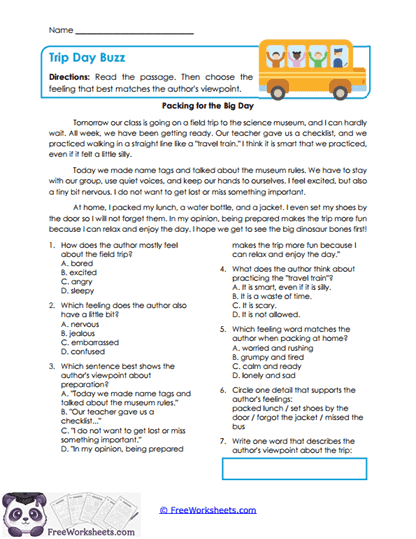
Trip Day Buzz helps Grade 3 students identify the author’s feelings and perspective within a narrative passage. Students read about a class field trip and analyze how the author feels before and during the trip. The passage includes emotional clues such as excitement, nervousness, and anticipation, allowing students to track how the author’s perspective develops. This worksheet strengthens students’ ability to connect emotions with point of view.
At the Grade 3 level, students are expected to recognize how an author’s feelings influence the tone and meaning of a text. In this worksheet, the author expresses excitement about the trip while also showing careful preparation and responsibility. Students must identify which words and phrases reveal these feelings. This builds a deeper understanding of how perspective is communicated through language.
The questions require students to support their answers with evidence from the text. They must choose sentences that best show the author’s viewpoint and explain their reasoning. This strengthens comprehension and encourages evidence-based thinking.
Curriculum and Grade Alignment
This worksheet aligns with Common Core RL.3.3 and RI.3.6, focusing on describing characters’ feelings and identifying the author’s point of view. It also supports RL.3.1 for answering questions using evidence. It aligns with TEKS Grade 3 ELAR standards related to analyzing perspective and emotional tone.
Students practice identifying feelings and connecting them to the author’s perspective. This strengthens both comprehension and analytical skills.
Student Tasks
Students read the passage carefully. They answer multiple-choice questions about how the author feels. They also identify sentences that support the author’s perspective.
Students must use evidence from the text. This builds reasoning skills. The structured questions reinforce understanding.
Common Challenges and Misconceptions
Some students may focus on events instead of feelings. Others may choose answers based on their own emotions rather than the author’s. Teachers should emphasize finding evidence in the passage.
Encouraging students to underline feeling words improves accuracy. Discussion strengthens comprehension.
Implementation Guidance
Use this worksheet during lessons on tone and perspective. Model identifying one feeling from the passage before independent work. Encourage students to explain how they know the author feels a certain way.
Partner discussion can deepen understanding.
Details and Features
Narrative passage about a field trip.
Focus on identifying emotions and perspective.
Includes evidence-based questions.