
About This Worksheet
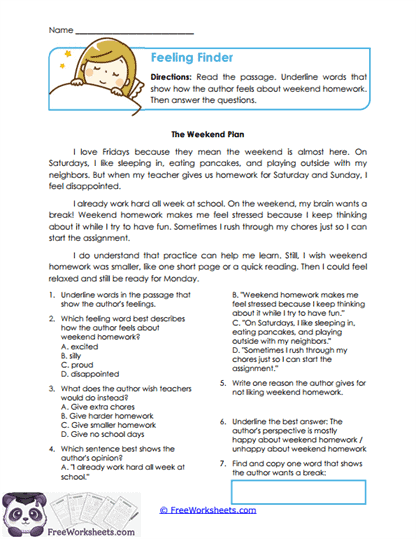
Feeling Finder helps Grade 3 students analyze an author’s emotions and perspective about a specific topic. Students read a passage about weekend homework and identify words that show how the author feels. This worksheet emphasizes emotional language and how it reveals the author’s attitude. By focusing on feelings, students develop a clearer understanding of perspective.
At the Grade 3 level, students must begin distinguishing tone and emotional expression in text. This worksheet supports that by asking students to underline feeling words such as “love,” “disappointed,” or “relaxed.” These words provide clues about the author’s opinion. Recognizing these clues strengthens comprehension and interpretation skills.
The follow-up questions require students to connect feelings to the author’s overall perspective. Students must explain why the author feels a certain way. This builds deeper analytical thinking and strengthens text-based reasoning.
Curriculum and Grade Alignment
This worksheet aligns with Common Core RI.3.6 and RL.3.1, focusing on identifying point of view and supporting answers with evidence. It also aligns with TEKS Grade 3 ELAR standards related to analyzing author perspective and tone.
Students practice identifying emotional language. This strengthens understanding of tone and viewpoint.
Student Tasks
Students read the passage carefully. They underline words that show the author’s feelings. They then answer questions about the author’s perspective.
Students must connect feelings to meaning. This strengthens comprehension. The tasks reinforce analytical thinking.
Common Challenges and Misconceptions
Students may focus on general ideas instead of specific feeling words. Others may confuse their own feelings with the author’s. Teachers should emphasize using evidence from the text.
Modeling how to identify feeling words supports clarity. Guided practice improves accuracy.
Implementation Guidance
Use this worksheet during lessons on tone and perspective. Encourage students to highlight emotional language. Discuss how word choice reveals opinion.
Partner discussion can deepen understanding.
Details and Features
Narrative-style passage with emotional language.
Focus on identifying feeling words.
Supports tone and perspective analysis.