
About This Worksheet
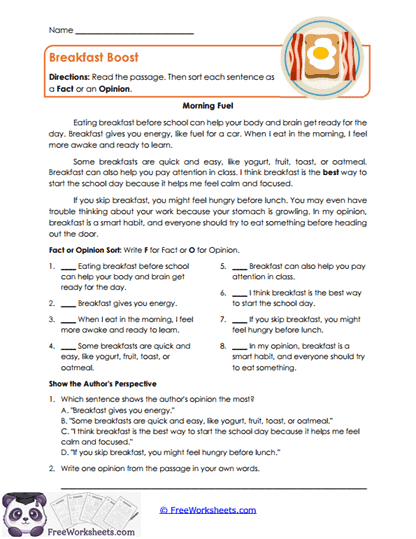
Breakfast Boost helps Grade 3 students distinguish between facts and opinions while identifying the author’s perspective in an informational passage. Students read a text about the importance of eating breakfast and then sort statements into fact or opinion categories. This worksheet strengthens students’ ability to recognize how authors combine factual information with personal beliefs to support a viewpoint. It also builds awareness of how opinions are often supported by reasons or examples.
At the Grade 3 level, students are expected to evaluate statements and determine whether they can be proven or are based on personal belief. In this passage, factual statements such as “Breakfast gives you energy” are combined with opinion statements like “In my opinion, breakfast is a smart habit.” This helps students understand how authors use both types of information together. Recognizing this difference is essential for developing critical reading skills.
The worksheet also includes questions about the author’s perspective. Students must identify which sentence best shows the author’s opinion and explain it in their own words. This builds deeper comprehension and encourages students to think beyond surface-level reading.
Curriculum and Grade Alignment
This worksheet aligns with Common Core RI.3.6, which focuses on distinguishing the author’s point of view. It also supports RI.3.1 and RI.3.8, which involve identifying supporting details and distinguishing fact from opinion. It aligns with TEKS Grade 3 ELAR standards related to analyzing author perspective and evaluating information.
Students practice separating fact from opinion while identifying the author’s viewpoint. This strengthens critical reading and reasoning skills.
Student Tasks
Students read the passage carefully. They label each statement as fact or opinion. They then answer questions about the author’s perspective and provide a written response.
Students must analyze statements closely. This builds reasoning skills. The written response strengthens comprehension.
Common Challenges and Misconceptions
Some students may confuse strong opinions with facts. Others may rely on personal beliefs instead of text evidence. Teachers should emphasize that facts can be proven, while opinions cannot.
Encouraging students to look for phrases like “I think” or “in my opinion” improves accuracy.
Implementation Guidance
Use this worksheet during lessons on fact and opinion. Model identifying one example of each before independent work. Encourage discussion about why certain statements are opinions.
Review answers together to reinforce understanding.
Details and Features
Informational passage about breakfast.
Fact vs. opinion sorting activity.
Focus on identifying author perspective.