
Social Emotional Worksheets
This comprehensive collection is thoughtfully designed to strengthen communication, self-awareness, relationship skills, and responsible decision-making-all while reinforcing core academic standards. Aligned with CASEL frameworks and grade-level expectations, these engaging activities build speaking, listening, critical thinking, and inquiry skills that support success across Language Arts, Math, Science, and Social Studies. By nurturing confidence, collaboration, and real-world problem-solving, this collection empowers students to grow both socially and academically.
Communication & Conversation Skills
About This Collection of Worksheets
This Social Emotional Printable Worksheet Collection is a standards-aligned resource designed to support the full spectrum of Social-Emotional Learning (SEL) competencies while reinforcing core academic development across grade levels. Grounded in CASEL-aligned frameworks and vertically aligned with elementary readiness standards, this collection strengthens communication skills, self-awareness, relationship-building strategies, and responsible decision-making. While centered on interpersonal development, these worksheets intentionally integrate Language Arts, critical thinking, and real-world application to ensure students build both social competence and academic confidence.
In the Language Arts domain, students are developmentally expected to master speaking and listening standards that include participating in collaborative conversations, asking and answering questions appropriately, and expressing ideas clearly. This collection reinforces foundational skills such as sentence formulation, question construction, conversational turn-taking, and contextual vocabulary usage. By practicing how to initiate dialogue and frame appropriate inquiries, learners strengthen oral language fluency, pragmatic communication, and comprehension. These standards-aligned activities promote conceptual understanding of audience, purpose, and tone while preparing students for grade-level mastery in discussion-based learning environments.
Although the focus is social-emotional development, Mathematics competencies are reinforced indirectly through logical reasoning and structured thinking. Effective questioning and conversation require sequencing thoughts, recognizing patterns in dialogue, and understanding cause-and-effect relationships. These cognitive processes parallel mathematical problem-solving and analytical reasoning expectations. By organizing thoughts before speaking and evaluating responses critically, students enhance executive-function skills that contribute to mathematical fluency and independent learning across disciplines.
Within Science, students are expected to engage in inquiry, ask purposeful questions, and communicate observations clearly. The ability to formulate appropriate questions is foundational to scientific investigation and evidence-based reasoning. This collection strengthens inquiry habits of mind by teaching students how to ask clarifying, respectful, and relevant questions-skills essential for life science exploration, physical science experiments, and collaborative group investigations. Developing structured dialogue also supports scientific discourse, fostering conceptual understanding and academic confidence in inquiry-based classrooms.
In History and Social Studies, communication plays a central role in civic engagement, cultural understanding, and collaborative problem-solving. Students must learn to listen actively, consider diverse perspectives, and engage respectfully in discussion. Worksheets focused on starting conversations and asking appropriate questions reinforce civic competencies such as empathy, perspective-taking, and responsible participation in group settings. These activities contribute to historical thinking and community awareness by helping students practice respectful dialogue-an essential component of democratic learning environments.
The Extras and Enrichment component of this collection is particularly strong. Social-emotional learning at any grade level depends on executive functioning, emotional regulation, self-management, and interpersonal awareness. These worksheets cultivate self-confidence, reduce social anxiety, and build independence in peer interactions. Students develop fine-tuned communication strategies that support collaboration, leadership readiness, and conflict resolution. By strengthening these foundational interpersonal skills, the collection ensures vertical alignment with academic expectations that increasingly rely on discussion, group projects, and student-led inquiry.
Together, this Social Emotional Worksheet Collection functions as a comprehensive tool for developing communication fluency, relational competence, and cross-curricular readiness. It supports grade-level mastery not only in SEL benchmarks but also in speaking, listening, reasoning, and collaborative learning standards. Educators and families can rely on this structured resource to build academic resilience, independent learning behaviors, and the interpersonal confidence necessary for long-term educational success.
A Look at the Categories of Worksheets
Asking Appropriate Questions
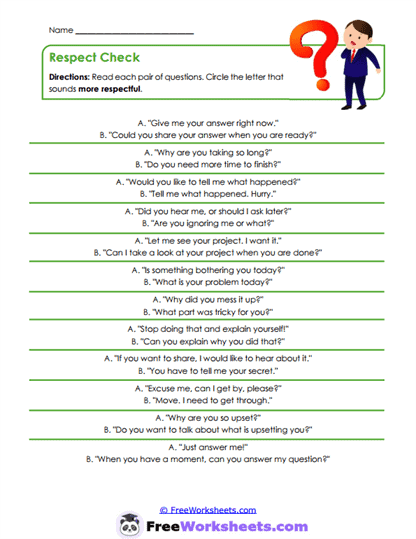
This sub-category directly supports Social-Emotional Learning and Language Arts speaking and listening standards by teaching students how to formulate respectful, relevant, and purposeful questions. Learners practice distinguishing between helpful and unhelpful inquiries, understanding context, and aligning questions with audience and situation. These activities strengthen conceptual understanding of communication norms while reinforcing sentence structure, vocabulary precision, and conversational fluency. By developing inquiry skills that transfer to academic discussions and scientific exploration, students build grade-level mastery in both interpersonal competence and academic reasoning.
Starting Conversations
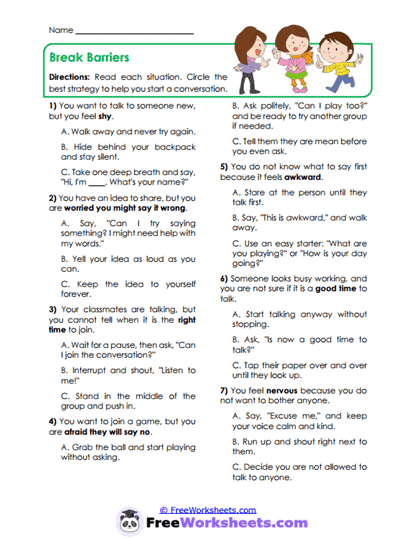
This sub-category focuses on initiating dialogue with confidence, clarity, and social awareness. Students learn how to introduce themselves, choose appropriate topics, and use open-ended prompts to sustain meaningful interaction. These worksheets reinforce standards-aligned expectations in oral communication, collaborative discussion, and perspective-taking. By practicing structured conversation starters, learners enhance executive-function skills, emotional regulation, and independent social problem-solving, contributing to both social development and cross-curricular academic success.