
About This Worksheet
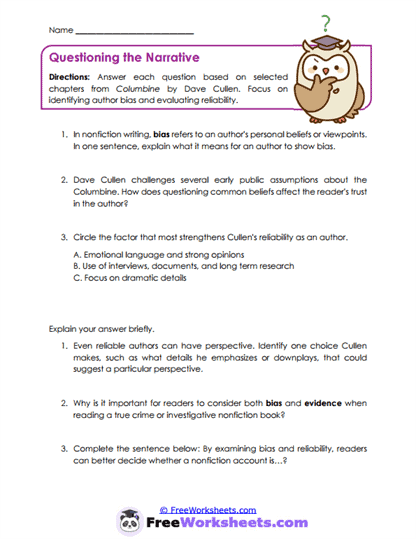
Questioning the Narrative is a grade 9 nonfiction analysis worksheet focused on identifying author bias and evaluating reliability in Columbine by Dave Cullen. It is a high school literacy resource that strengthens students’ ability to distinguish between perspective and evidence. The worksheet asks students to consider how Cullen challenges common assumptions about the event. For example, analyzing the use of interviews and long-term research helps students evaluate credibility. This activity develops critical reading skills necessary for analyzing investigative nonfiction.
Curriculum and Grade Alignment
This worksheet is designed for Grade 9 and emphasizes evaluating author bias and credibility in nonfiction texts. The primary learning goal is to explain how evidence and perspective influence reader trust. Students should already understand how to identify claims and supporting evidence before completing this task. The next progression skill involves comparing multiple sources for bias and reliability. This resource aligns with CCSS.ELA-LITERACY.RI.9-10.8, which focuses on evaluating arguments and claims.
Student Tasks
On this worksheet, students will define bias in their own words. They analyze how Cullen’s research methods affect credibility. Learners evaluate which factors strengthen reliability. Students explain why readers must consider both bias and evidence when reading nonfiction. Each response requires thoughtful reasoning and textual understanding.
Common Challenges and Misconceptions
Students may confuse bias with dishonesty rather than recognizing it as perspective. Some learners might assume all nonfiction is fully objective. Others may struggle to distinguish between opinion and evidence. Explaining reliability clearly can also be challenging. Teachers can model analyzing evidence types such as interviews and documentation.
Implementation Guidance
Teachers can use this worksheet during a unit on investigative journalism or nonfiction credibility. It works well as preparation for research projects. In small groups, students can debate how bias influences interpretation. Homeschool educators may guide reflective discussions about evaluating sources. The worksheet supports media literacy and analytical reasoning.
Details and Features
The worksheet includes structured analytical questions focused on bias and reliability. Prompts encourage explanation and justification. The layout provides space for concise written responses. The printable format is classroom-ready and easy to distribute. The investigative topic promotes thoughtful discussion.