
About This Worksheet
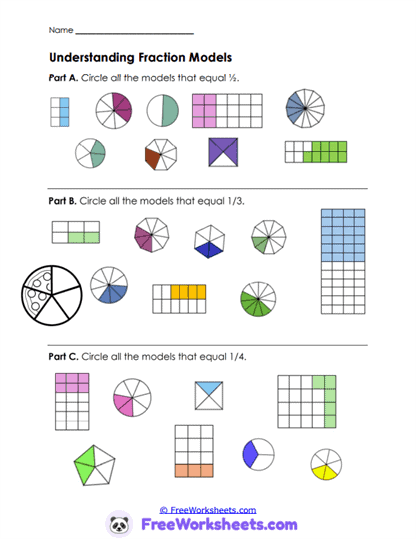
This worksheet helps students connect visual fraction models to fraction values like one half, one third, and one fourth. Learners study shaded shapes and decide which models correctly represent the target fraction. Visual fraction activities strengthen understanding of equal parts and fraction size relationships. For example, a rectangle with 2 out of 4 equal parts shaded represents 1/2 because two fourths equals one half. This activity supports deeper fraction understanding through pictures and hands-on thinking.
Curriculum and Grade Alignment
This worksheet focuses on recognizing equivalent fractions and interpreting visual fraction models. Students should already understand basic fractions and equal partitioning before beginning this activity. The learning goal is helping learners identify fractions visually and connect models to written fraction values. After mastering this skill, students are better prepared for comparing fractions and simplifying equivalent fractions. The worksheet aligns with Common Core standard 5.NF.A.1 and TEKS 5.3B involving equivalent fractions and visual representations.
Student Tasks
On this worksheet, students will
study groups of fraction models and determine which pictures equal a target fraction value. Students circle all visual models that correctly match fractions such as one half, one third, and one fourth. Learners compare shaded portions carefully to decide whether the models represent the same amount. Several activities encourage students to think about both the number and size of equal parts. Students also practice recognizing equivalent fractions through visual reasoning.
Common Challenges and Misconceptions
Many students focus only on the number of shaded pieces instead of the size of the pieces. Some learners struggle to recognize that different-looking models can still represent the same fraction amount. Others may incorrectly count unequal parts when comparing models. Students can also become confused when shapes are divided differently but still show equivalent values. Teachers can help by using hands-on manipulatives and discussing equal partitioning before independent practice.
Implementation Guidance
Teachers can use this worksheet during visual fraction lessons, math centers, or guided small-group instruction. The activity works especially well for students who benefit from picture-based learning and concrete examples. Parents and homeschool educators may complete one section together before encouraging independent completion. Fraction circles, pattern blocks, and drawings can provide additional support for struggling learners. This worksheet also works well for review or intervention practice.
Details and Features
This printable worksheet includes multiple visual fraction models using circles, rectangles, and divided shapes. Students compare and identify models that match specific fraction values. The page layout is organized clearly to support focused problem solving and visual analysis. Friendly illustrations create an engaging learning experience while maintaining academic structure. The worksheet is suitable for classroom instruction, tutoring, intervention, or homeschool use.