
About This Worksheet
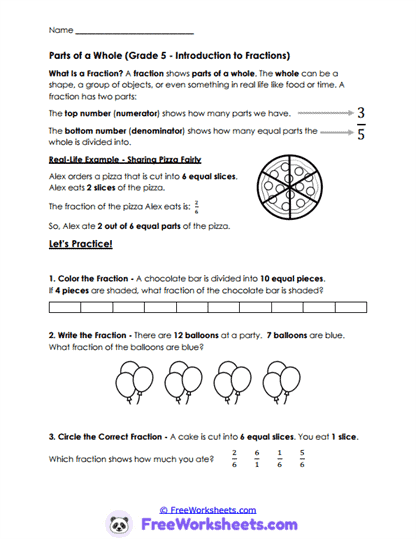
This worksheet introduces students to the basic idea of fractions and how fractions represent parts of a whole. Learners study numerators and denominators while connecting fractions to real-world examples like pizza slices and chocolate bars. Fractions show how many equal parts are being used compared to the total number of equal parts. For example, 3/5 means three out of five equal parts are selected. This activity helps students build a strong foundation before moving into more advanced fraction skills.
Curriculum and Grade Alignment
This worksheet focuses on introductory fraction concepts and fraction vocabulary. Students should already understand equal groups and division concepts before beginning this activity. The main learning goal is helping learners recognize fractions as parts of a whole and correctly identify numerators and denominators. After mastering this skill, students are better prepared for comparing, adding, and simplifying fractions. The worksheet aligns with Common Core standard 5.NF.A.1 and TEKS 5.3A involving fraction representation and understanding.
Student Tasks
On this worksheet, students will
identify fractions represented by shaded models and real-world examples. Students read explanations about numerators and denominators before completing practice problems. Learners write fractions based on pictures and determine how many equal parts are shaded. Several activities encourage students to connect fractions to everyday objects like pizzas and candy bars. Students also practice recognizing correct fraction notation.
Common Challenges and Misconceptions
Many students confuse the numerator and denominator when first learning fractions. Some learners struggle to understand that fractions must represent equal-sized parts of a whole. Others may count pieces incorrectly when looking at visual models. Students can also become confused when translating pictures into written fractions. Teachers can help by using hands-on models and repeated visual examples during instruction.
Implementation Guidance
Teachers can use this worksheet during introductory fraction lessons or small-group review sessions. The guided explanations make it useful for direct teaching before independent practice begins. Parents and homeschool educators may read through the examples aloud before helping children complete the practice section. Fraction circles, paper folding, or food examples can support deeper understanding. This worksheet also works well for intervention and reinforcement activities.
Details and Features
This printable worksheet includes fraction explanations, labeled examples, and beginner-friendly practice problems. The page combines instruction and independent work in one organized format. Friendly illustrations help maintain student interest while supporting visual learning. The clean layout makes the worksheet easy to follow for developing learners. It is suitable for classroom instruction, tutoring sessions, or homeschool use.