
About This Worksheet
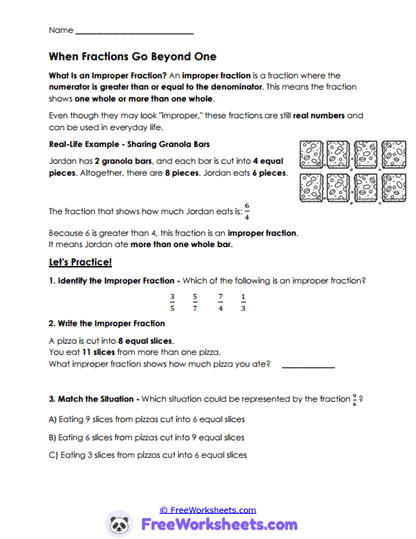
This worksheet teaches students about improper fractions and how fractions can represent amounts greater than one whole. Learners explore examples showing that improper fractions have numerators larger than or equal to their denominators. Real-world examples help students understand that fractions larger than one are still meaningful numbers. For example, 6/4 means six fourth-size pieces, which is more than one whole. This activity builds understanding of improper fractions before students begin converting between fraction forms.
Curriculum and Grade Alignment
This worksheet focuses on understanding improper fractions and recognizing fractions greater than one whole. Students should already understand basic fractions and equal parts before completing this activity. The main learning goal is helping learners identify improper fractions and connect them to real-world situations. After mastering this skill, students are prepared to convert improper fractions into mixed numbers. The worksheet aligns with Common Core standard 5.NF.B.3 and TEKS 5.3C involving fraction representation and interpretation.
Student Tasks
On this worksheet, students will
identify improper fractions from sets of choices and real-world examples. Students analyze fraction situations involving pizzas and snack bars to determine the correct improper fraction. Learners match fraction descriptions to the situations they represent. Several activities encourage students to recognize when a fraction is greater than one whole. Students also practice connecting visual examples to written fractions.
Common Challenges and Misconceptions
Some students believe fractions cannot be larger than one whole. Others may struggle to understand why the numerator can be greater than the denominator. Learners sometimes confuse improper fractions with mixed numbers during practice. Students may also have trouble connecting fraction values to real-life examples. Teachers can help by using visual fraction models that clearly show more than one whole object.
Implementation Guidance
Teachers can use this worksheet during fraction introduction lessons or guided math instruction. The combination of explanation and practice makes it useful for classroom modeling and independent review. Parents and homeschool educators may benefit from discussing each real-world example aloud before students answer independently. Fraction strips and visual manipulatives can support learners who need additional reinforcement. The worksheet also works well for review before mixed-number lessons.
Details and Features
This printable worksheet includes instructional examples, real-world fraction scenarios, and guided practice questions. The page layout supports step-by-step learning and organized problem solving. Child-friendly graphics help create an engaging learning environment without distracting from the math concepts. The worksheet combines conceptual understanding with practical application activities. It prints clearly for classroom, tutoring, or homeschool use.