
About This Worksheet
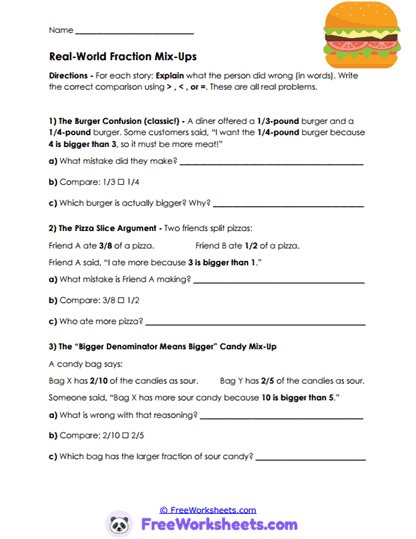
This worksheet helps students identify common mistakes people make when comparing fractions in real-world situations. Learners read short scenarios and explain why the fraction reasoning is incorrect before solving the comparison correctly. Real-world fraction examples help students understand that larger numbers do not always mean larger fractions. For example, someone may incorrectly think 1/4 is larger than 1/3 because four is bigger than three, even though fourths are smaller pieces. This activity strengthens critical thinking and deeper understanding of fraction size.
Curriculum and Grade Alignment
This worksheet focuses on fraction comparison, reasoning, and mathematical explanation skills. Students should already understand basic fraction comparison strategies before attempting this activity. The learning goal is helping learners recognize common fraction misconceptions and explain correct reasoning clearly. After mastering this skill, students are better prepared for multi-step fraction problems and mathematical discussions. The worksheet aligns with Common Core standards 5.NF.A.1 and 5.MP.3, along with TEKS 5.1D and 5.3D involving mathematical communication and fraction concepts.
Student Tasks
On this worksheet, students will
read real-world fraction comparison scenarios involving common misunderstandings. Students explain what mistake each person made while comparing the fractions. Learners compare the fractions correctly using greater than, less than, or equal symbols. Several questions encourage students to justify their answers using clear mathematical reasoning. Students also practice connecting fraction concepts to everyday examples involving food and measurements.
Common Challenges and Misconceptions
Many students believe fractions with larger denominators are always larger values. Some learners focus only on the numbers in the fraction without thinking about the size of the pieces. Others may struggle to explain their reasoning clearly even when they know the correct answer. Students can also become confused when comparing fractions close to one whole. Teachers can support understanding by encouraging students to draw visual models for each scenario.
Implementation Guidance
Teachers can use this worksheet during fraction reasoning lessons, partner discussions, or math intervention groups. The activity works well for building classroom conversations around mathematical thinking and misconceptions. Parents and homeschool educators may read each scenario aloud before discussing the reasoning together. Students often benefit from using visual fraction models while explaining their answers. This worksheet is also useful for strengthening written math explanations and critical-thinking skills.
Details and Features
This printable worksheet includes real-world fraction comparison stories and written response questions. Students compare fractions while explaining mathematical misunderstandings in everyday situations. The page layout provides space for written explanations and problem solving. Friendly illustrations help create an engaging learning experience while keeping the focus on mathematics. The worksheet is suitable for classroom instruction, tutoring sessions, or homeschool enrichment.