
About This Worksheet
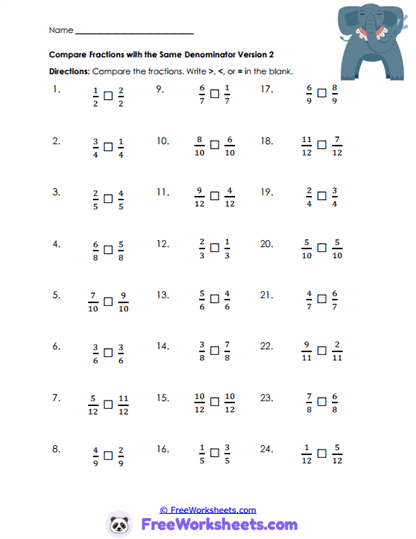
This worksheet gives students additional practice comparing fractions with the same denominator. Learners strengthen fraction sense by focusing on the numerators to determine which fraction is larger. Fractions with matching denominators represent equal-sized parts, making comparison easier for developing mathematicians. For example, 7/10 is greater than 3/10 because seven tenths is more than three tenths. This activity helps students improve accuracy and confidence with fraction comparisons.
Curriculum and Grade Alignment
This worksheet focuses on comparing fractions that have common denominators. Students should already understand basic fraction vocabulary and how fractions represent parts of a whole. The primary learning goal is helping learners compare fractions correctly using mathematical symbols. After completing this skill, students are prepared to compare fractions with different denominators and equivalent fractions. The worksheet aligns with Common Core standard 5.NF.A.1 and TEKS 5.3D involving fraction relationships.
Student Tasks
On this worksheet, students will
compare pairs of fractions that share the same denominator. Students determine whether each fraction is greater than, less than, or equal to the other fraction. Learners write comparison symbols in the provided spaces to complete each statement. Several problems encourage students to carefully study the numerators before answering. Students also practice reading fractions correctly and checking their work for accuracy.
Common Challenges and Misconceptions
Some students mistakenly think larger denominators always mean larger fractions. Others may reverse the meaning of greater than and less than symbols during practice. Learners sometimes rush and compare the wrong numbers in the equation. Students may also struggle to understand why the numerators control the comparison when denominators match. Teachers can support understanding by using visual fraction models and reviewing comparison vocabulary regularly.
Implementation Guidance
Teachers may use this worksheet during guided math lessons, review activities, or intervention groups. The activity also works well for warm-ups or independent seatwork practice. Parents and homeschool educators can solve a few examples aloud with children before assigning independent completion. Visual supports like number lines or fraction circles may help struggling learners. The worksheet provides focused repetition that supports long-term fraction fluency.
Details and Features
This worksheet contains twenty-four fraction comparison problems with matching denominators. The organized formatting supports neat work and easy reading for students. Friendly illustrations help create a welcoming learning environment while maintaining focus on math instruction. The printable design works well for classroom lessons, tutoring sessions, or homeschool review. Repeated practice helps students build confidence and improve comparison accuracy.