
Author's Perspective Worksheets
Grade 4 reading Author's Perspective worksheets help students analyze tone, opinion, and point of view through engaging informational and literary passages. These free, ready-to-print resources are provided in PDF format for immediate classroom use. Students strengthen fact-and-opinion analysis, perspective identification, and evidence-based reasoning aligned to Common Core standards.
About This Collection of Worksheets
Author’s perspective becomes increasingly important in Grade 4 as students move beyond basic comprehension and begin analyzing how writers communicate opinions, attitudes, and beliefs. These worksheets support that developmental shift by aligning with Common Core standards such as RI.4.6, RI.4.8, RI.4.9, and RL.4.3, helping students distinguish fact from opinion, identify tone, compare viewpoints, and explain how language reveals perspective. Through repeated practice with varied passages, students learn to read more critically and support their thinking with textual evidence.
This collection works well across a wide range of instructional settings, including morning work, homework, RTI support, literacy centers, small groups, and formative assessment. Teachers can use these resources to introduce author’s perspective, reinforce key academic vocabulary, or check whether students can independently analyze opinion and tone in text. With activities that include classification, comparison, inference, and explanation, students gain broad exposure to perspective analysis in meaningful contexts.
Each worksheet is designed for strong print quality, low ink use, and easy accessibility for classroom and homeschool settings. The layouts are clean, readable, and low-prep, allowing teachers to use them quickly without extra materials or setup. Clear directions and focused response areas help students stay organized while practicing higher-level reading skills.
Paul’s Teacher Tip
When teaching author’s perspective, remind students to look closely at the words an author chooses, not just the topic being discussed. Many Grade 4 learners can spot a clear opinion word like amazing or terrible, but they often need support noticing subtler clues that show tone or bias. Model how to ask, “How does the author feel about this subject?” and “Which words prove that?” For students who need more support, provide sentence stems such as “The author seems to believe…” or “I know this because the text says…,” and for stronger readers, ask them to explain whether the passage feels balanced or one-sided. Frequent discussion and text-based justification will help students build confidence in analyzing viewpoint.
Worksheet Collection Skill Spotlights
Ancient Tree Care
- What Kids Do:
Students read a conservation passage, highlight statements that reveal a strong viewpoint, and identify the reasons that support the writer’s stance. - Target Skill:
Builds perspective recognition by analyzing persuasive wording and connecting opinions to supporting ideas in informational text.
Beach Bots
- What Kids Do:
Learners examine a passage about beach-cleaning robots and decide whether the writer mostly supports or questions the idea, using evidence from the text. - Target Skill:
Strengthens argument interpretation by evaluating tone, reasoning, and the overall position an author takes on a topic.
Billboard Watch
- What Kids Do:
Students read a persuasive passage about highway billboards, circle loaded words and phrases, and explain what those choices reveal about the writer’s attitude. - Target Skill:
Develops language analysis by identifying opinion-driven vocabulary that signals viewpoint and emotional stance.
Clock Tower Talk
- What Kids Do:
Students read about a proposed clock tower project and classify statements as either neutral information or author perspective based on wording and evidence. - Target Skill:
Builds critical literacy by distinguishing objective details from subjective claims in informational writing.
Drone Debate
- What Kids Do:
Learners read an argument about neighborhood drones, identify the author’s opinion, and determine whether the passage presents one side or a balanced discussion. - Target Skill:
Strengthens bias detection by analyzing how arguments are framed and whether multiple viewpoints are fairly represented.
Maze Adventure
- What Kids Do:
Students read a narrative about exploring a maze and track how the emotional tone changes from one part of the story to another. - Target Skill:
Develops narrative tone analysis by examining how events and word choice shape shifting feelings in literary text.
Night Market Buzz
- What Kids Do:
Students read a descriptive passage about a night market, underline opinion words, and decide whether the author feels positively or negatively about the experience. - Target Skill:
Builds tone awareness by identifying expressive language that reveals a writer’s attitude toward a subject.
Ocean Hotel Guess
- What Kids Do:
Learners read the beginning of a passage about underwater hotels, predict the author’s viewpoint, and cite words and phrases that support that prediction. - Target Skill:
Strengthens inferential reasoning by using early textual clues to anticipate perspective and tone before reading further.
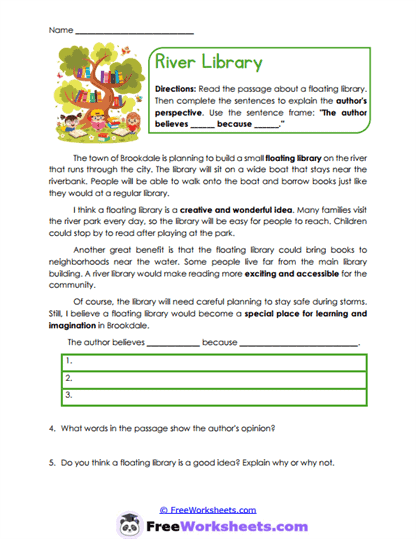
River Library
- What Kids Do:
Students read about a floating library, complete sentence frames explaining the author’s beliefs, and support their responses with evidence from the passage. - Target Skill:
Develops explanation skills by connecting opinion language to clear, text-based reasoning about author beliefs.
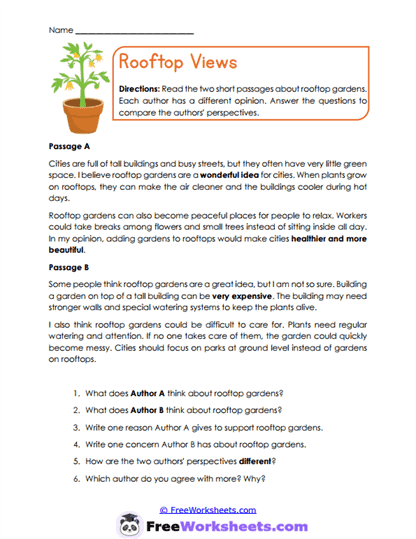
Rooftop Views
- What Kids Do:
Students read two passages with different opinions about rooftop gardens and compare the viewpoints and reasons given in each one. - Target Skill:
Builds cross-text analysis by identifying similarities and differences in perspective across paired informational texts.
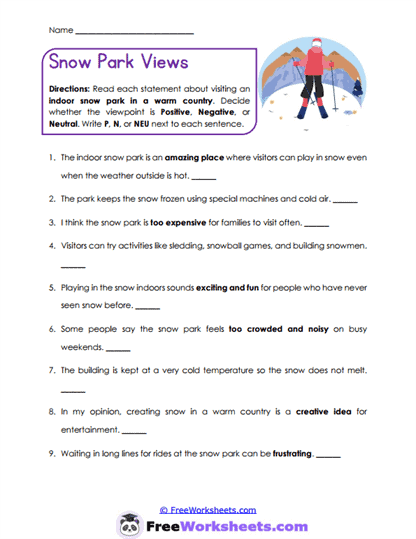
Snow Park Views
- What Kids Do:
Learners read statements about a snow park, label each as positive, negative, or neutral, and determine the overall tone created by the language. - Target Skill:
Strengthens viewpoint classification by sorting statements according to attitude and interpreting tone from word choice.
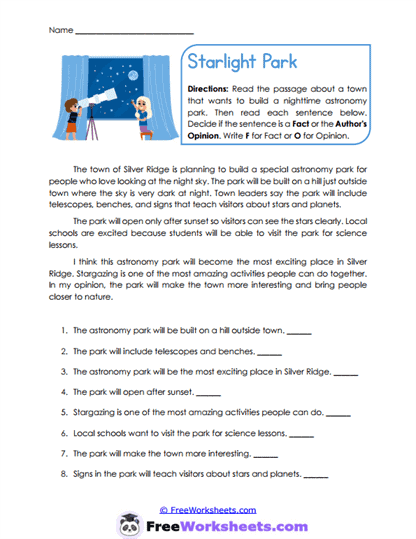
Starlight Park
- What Kids Do:
Students read about a proposed astronomy park and label each statement as fact or opinion by checking whether it can be proven or reflects a belief. - Target Skill:
Develops fact-versus-opinion analysis by helping students separate verifiable information from personal judgments in informational text.