
About This Worksheet
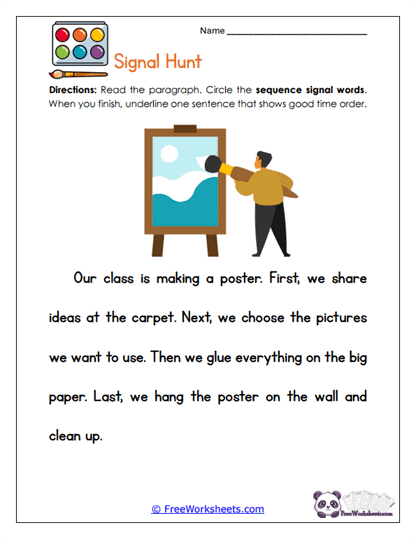
Signal Hunt focuses on helping Grade 2 students identify and understand sequence signal words within a paragraph. Students read a short informational paragraph about making a class poster and are asked to circle the sequence signal words such as First, Next, Then, and Last. After identifying the signal words, students underline one sentence that clearly shows strong time order. This worksheet strengthens students’ awareness of how authors organize ideas chronologically.
At the Grade 2 level, students are expected to recognize transition words that signal order and progression. Sequence signal words are essential for both reading comprehension and writing development. By explicitly identifying these words, students learn how authors guide readers through steps and events. This awareness supports students when they write their own procedural or narrative texts.
The paragraph format allows students to see signal words used naturally in context. Instead of isolated vocabulary practice, they analyze real text structure. This builds deeper comprehension and strengthens organizational reading skills.
Curriculum and Grade Alignment
This worksheet aligns with Common Core RI.2.3, which requires students to describe the connection between events and steps in procedures. It also supports RL.2.5, focusing on understanding text structure. It aligns with TEKS Grade 2 ELAR standards related to sequencing and identifying signal words in informational texts.
Students practice identifying transitions that organize events. This strengthens comprehension of chronological text structure.
Student Tasks
Students read the paragraph carefully. They circle each sequence signal word in the passage. Afterward, they underline one sentence that clearly demonstrates time order.
Students must reread closely to ensure all signal words are identified. This builds careful reading habits. The underlining task reinforces comprehension.
Common Challenges and Misconceptions
Some students may overlook signal words if they read too quickly. Others may circle words that are not actual time transitions. Teachers should model identifying one example before independent work.
Encourage students to ask whether the word shows order in time. Guided questioning improves accuracy.
Implementation Guidance
Introduce common sequence signal words before assigning the worksheet. Provide anchor chart examples such as First, Next, Then, Last, Finally. Encourage students to explain how the signal word helps organize events.
Review answers as a class and discuss how signal words improve clarity. This reinforces writing connections.
Details and Features
Short informational paragraph.
Explicit identification of sequence signal words.
Supports chronological reading comprehension.