
About This Worksheet
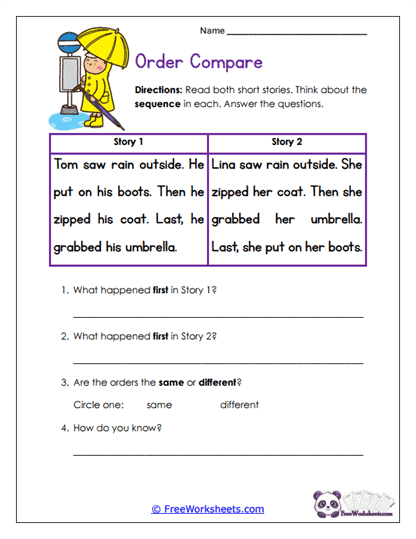
Order Compare helps Grade 2 students strengthen sequencing comprehension by comparing the order of events in two short stories. Students read two simple passages about Tom and Lina preparing for rainy weather. Although the stories contain the same actions, the order of events is different. This worksheet encourages students to examine how the sequence of events can change even when the actions remain the same.
At the Grade 2 level, students are expected to recognize chronological order and understand that sequence affects how a story unfolds. By comparing two versions of a similar situation, students learn to analyze text more carefully. They must identify which event happens first in each story and then determine whether the sequences match. This comparison builds deeper comprehension skills.
The worksheet also encourages students to explain their reasoning. Writing how they know the sequences are the same or different strengthens analytical thinking and reinforces reading evidence skills. This activity builds both comprehension and reasoning.
Curriculum and Grade Alignment
This worksheet aligns with Common Core RL.2.1 and RI.2.3, which focus on identifying key details and describing connections between events. It also supports RL.2.5, which emphasizes understanding story structure. It aligns with TEKS Grade 2 ELAR standards related to sequencing and comprehension.
Students practice analyzing and comparing chronological structures across texts. This strengthens critical reading skills.
Student Tasks
Students read both short passages carefully. They answer questions identifying what happened first in each story. They then determine whether the sequences are the same or different.
Students must justify their answers with reasoning. This strengthens comprehension. The comparison structure builds analytical thinking.
Common Challenges and Misconceptions
Some students may assume the stories have the same sequence because the actions are similar. Others may overlook small details that reveal the difference. Teachers should encourage students to reread both passages closely.
Highlighting sequence words helps improve accuracy. Guided discussion strengthens understanding.
Implementation Guidance
Use this worksheet during lessons about comparing texts or sequencing events. Encourage students to underline sequence signal words. Discuss how changing the order of actions can affect a story.
Pair discussion can help students explain their reasoning clearly.
Details and Features
Two short comparison passages.
Sequence analysis questions.
Focus on comparing chronological order.