
About This Worksheet
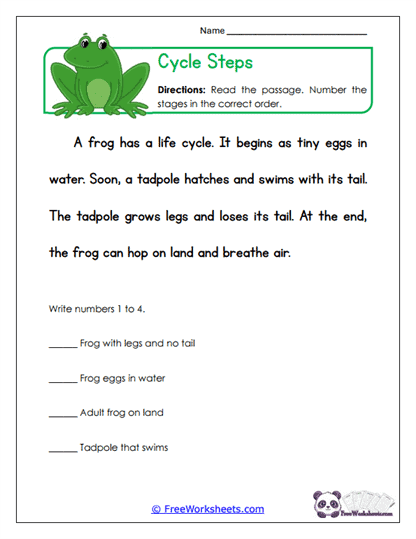
Cycle Steps introduces Grade 2 students to sequencing within a life cycle informational passage. Students read about the frog life cycle and number the stages in the correct order. This worksheet combines science content with reading comprehension, reinforcing the idea that sequencing applies to informational texts as well as narratives.
At the Grade 2 level, students are learning to interpret informational text structures such as life cycles and processes. This worksheet requires them to track developmental stages logically from beginning to end. Students must understand that frog eggs come before tadpoles, and tadpoles come before adult frogs. This builds scientific reasoning alongside literacy skills.
The numbered stage format strengthens organizational thinking. Students must carefully match each stage description to the correct position in the cycle. This reinforces cause-and-effect understanding within developmental processes.
Curriculum and Grade Alignment
This worksheet aligns with Common Core RI.2.3, focusing on describing the connection between a series of events or steps in a process. It also supports RL.2.5 for understanding structure. It aligns with TEKS Grade 2 ELAR informational text sequencing standards.
Students practice sequencing within a scientific context. This strengthens cross-curricular comprehension skills.
Student Tasks
Students read the frog life cycle passage carefully. They number the listed stages 1 through 4 in correct order. Each stage must reflect the proper developmental sequence.
Students analyze growth progression. This builds comprehension and reasoning. The numbering format supports organization.
Common Challenges and Misconceptions
Students may confuse middle stages such as tadpole and frog with legs. Others may not reread carefully. Teachers should encourage underlining stage clues.
Modeling the first stage clarifies expectations. Discussion strengthens understanding.
Implementation Guidance
Use this worksheet during science integration lessons. Connect sequencing to real-world life cycles. Encourage students to explain why one stage comes before another.
Review answers together to reinforce comprehension.
Details and Features
Informational life cycle passage.
Four-stage sequencing activity.
Cross-curricular literacy integration.