
About This Worksheet
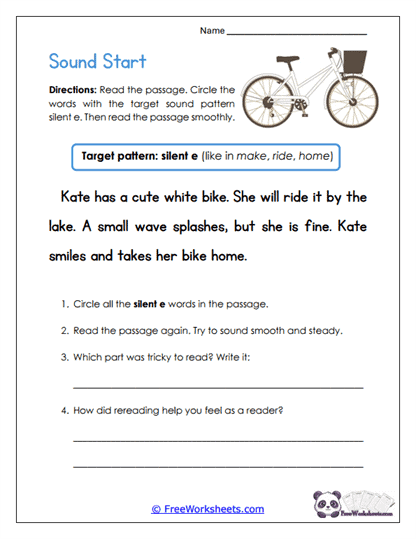
This worksheet is a targeted phonics fluency activity designed to strengthen recognition of the silent e (VCe) sound pattern. Students read a short decodable passage and identify words that follow the long vowel silent e pattern. Intended for first and early second grade learners, it supports phonics mastery and smooth oral reading development. The activity emphasizes decoding words such as bike, ride, and lake within connected text. For example, the word bike follows the VCe pattern where the final e makes the vowel say its name. This structured format reinforces automaticity with long vowel decoding.
Curriculum and Grade Alignment
This worksheet aligns with early elementary foundational reading standards focused on phonics and word recognition. The primary learning goal is helping students identify and decode long vowel words with silent e accurately. Students should already be familiar with short vowel sounds and basic CVC words before completing this activity. The content supports Common Core Standard RF.1.3.C, which addresses decoding regularly spelled one-syllable words with long vowel patterns. It also reinforces RF.1.4 for reading with sufficient accuracy and fluency. This resource builds the bridge from isolated phonics practice to connected text reading.
Student Tasks
On this worksheet, students will read a short passage containing multiple silent e words. They circle all words that follow the target long vowel pattern. Students then reread the passage smoothly to build fluency. Additional prompts ask learners to reflect on tricky parts and rereading strategies. The task integrates phonics identification with comprehension and fluency practice. Learners strengthen decoding accuracy within meaningful text.
Common Challenges and Misconceptions
Students may circle words that end in e but do not follow the silent e pattern. Some learners might mispronounce long vowel sounds if they revert to short vowel decoding. Others may overlook target words while focusing on comprehension. Confusion can occur when encountering unfamiliar vocabulary. Additionally, students may rush through rereading without improving smoothness. Teachers can model identifying the vowel-consonant-e pattern before independent practice.
Implementation Guidance
Teachers can use this worksheet during guided reading or phonics small groups. It works well as independent decoding practice after silent e instruction. Repeated reading aloud strengthens fluency and confidence. Parents and homeschool educators may use this worksheet to reinforce long vowel practice at home. Encouraging students to highlight vowel patterns before reading supports accuracy. This activity also serves as a quick phonics mastery check.
Details and Features
The worksheet includes a clearly labeled target phonics pattern. A short decodable passage provides contextualized practice. Follow-up questions promote rereading and reflection. The layout is clean and developmentally appropriate. The black-and-white printable format supports classroom efficiency. Its structured design supports systematic phonics instruction.