
About This Worksheet
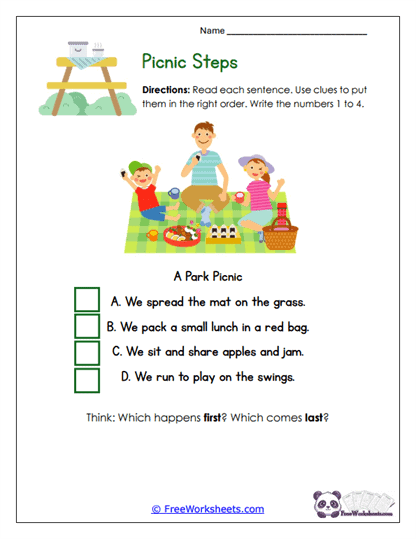
This worksheet is a sequencing and comprehension activity built around a short narrative scenario. Students read simple sentences about a park picnic and determine the correct order of events. Designed for kindergarten through second grade learners, it strengthens reading comprehension and sequencing skills. The activity emphasizes identifying what happens first, next, and last. For example, spreading the mat happens before sitting down to eat. This structured format builds logical reasoning within early reading practice.
Curriculum and Grade Alignment
This worksheet aligns with early elementary reading standards focused on sequencing events in a story. The primary objective is helping students identify the order of actions within a narrative. Students should already demonstrate basic decoding skills before completing this activity. The content supports Common Core Standards RL.K.1 and RL.1.3, which emphasize understanding key details and describing events in order. It also reinforces foundational comprehension strategies. This resource strengthens narrative understanding and procedural reasoning.
Student Tasks
On this worksheet, students will read short sentences describing picnic activities. They determine which event happens first, which happens next, and which happens last. Students write the numbers 1-4 beside each sentence to show correct order. Careful reading is required to identify contextual clues. Learners must analyze how events logically unfold. The task promotes sequencing and comprehension simultaneously.
Common Challenges and Misconceptions
Students may guess the order based on personal experience rather than textual evidence. Some learners might confuse middle events when actions appear similar. Others may overlook time-order clues embedded in the sentences. Confusion can arise if students do not reread before deciding. Additionally, rushing may lead to incorrect numbering. Teachers can model how to underline clues that signal sequence.
Implementation Guidance
Teachers can use this worksheet during literacy lessons focused on story structure. It works effectively as small-group practice in sequencing skills. Class discussion allows students to explain their reasoning. Parents and homeschool educators may use this worksheet to reinforce narrative comprehension at home. Encouraging students to retell the story aloud strengthens understanding. This activity also serves as a formative comprehension assessment.
Details and Features
The worksheet includes clearly labeled sentence options for sequencing. A simple numbering system allows organized responses. The layout is visually accessible for early readers. The black-and-white printable format supports classroom copying. Sentences use controlled vocabulary for readability. Its structured design supports foundational reading development.