
About This Worksheet
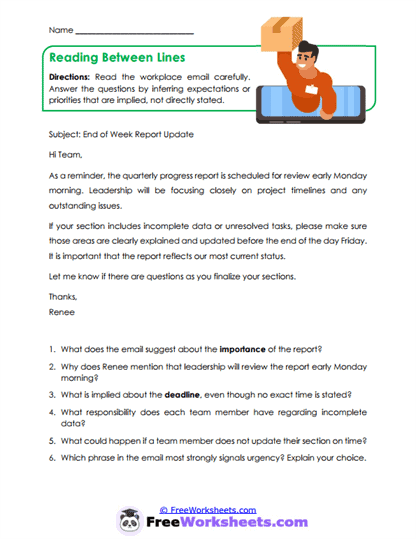
Reading Between Lines is a grade 10 business communication worksheet focused on making logical inferences from professional emails. It is a high school career-readiness resource designed to strengthen students’ ability to interpret implied expectations, priorities, and urgency in workplace writing. The email in this activity appears straightforward, but it contains subtle signals about accountability, deadlines, and leadership review. For example, mentioning that leadership will review the report early Monday morning implies high stakes and limited flexibility. This worksheet develops students’ ability to analyze tone, implied meaning, and professional expectations beyond surface-level comprehension.
Curriculum and Grade Alignment
This worksheet is designed for Grade 10 and emphasizes close reading of informational texts, particularly workplace communication. The primary learning goal is to identify what is implied but not directly stated in professional correspondence. Students should already understand how to identify explicit details before engaging in inference-based analysis. The next progression skill involves composing professional messages that communicate urgency and expectations clearly. This resource aligns with CCSS.ELA-LITERACY.RI.9-10.1 and RI.9-10.6, which focus on citing evidence and analyzing author purpose and tone.
Student Tasks
Students read a workplace email about an end-of-week report. They answer inference-based questions about urgency, expectations, and implied consequences. Learners identify phrases that signal importance and explain what they suggest about accountability. Students analyze how leadership involvement increases the significance of the task. Each response requires citing specific wording and explaining how it supports the inference.
Common Challenges and Misconceptions
Students may focus only on literal content without recognizing implied pressure or urgency. Some learners might confuse inference with personal opinion instead of grounding responses in text evidence. Others may overlook subtle language cues such as reminders or references to leadership. Teachers can model identifying key phrases that hint at expectations and discussing how tone communicates importance.
Implementation Guidance
This worksheet works well in business communication, career readiness, or professional writing units. Teachers can follow up by having students rewrite the email to make expectations either more direct or more subtle. In group discussions, students can compare how different phrases signal urgency. Homeschool educators may use this activity to discuss real-world workplace expectations and accountability. The worksheet supports practical reading skills for future employment settings.
Details and Features
The worksheet includes a realistic workplace email and six inference-based questions. Prompts require textual evidence and explanation rather than simple recall. The layout provides structured response space for analytical answers. The printable format is classroom-ready and suitable for individual or group use. The professional scenario promotes authentic, real-world literacy skills.