
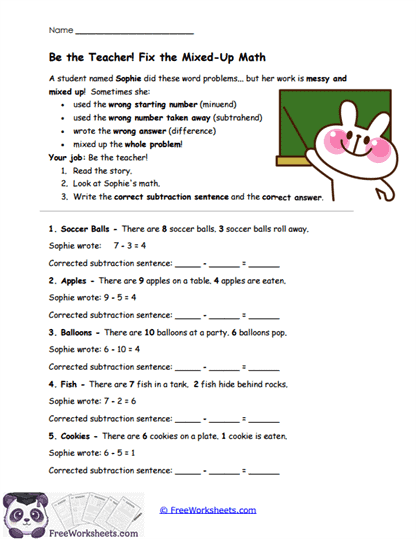
About This Worksheet
This worksheet blends subtraction with drawing, which is a great combination for young learners. It helps first graders visualize what is happening in each word problem. Instead of only solving with numbers, students also create a picture to match the story. That extra step makes the math more concrete and easier to understand. It’s especially helpful for kids who learn best through visuals.
Curriculum and Grade Alignment
This activity supports Grade 1 math skills in subtraction and representation. The goal is to help students understand subtraction by connecting it to drawings and real situations. Students should already have some experience solving basic subtraction problems. It aligns with Common Core Standard 1.OA.A.1, focusing on solving and representing word problems. In TEKS, it connects with 1.3(A) for understanding subtraction situations.
Student Tasks
Students read each subtraction story problem carefully. Then they solve the problem to find how many are left. After solving, they draw a picture that shows what happened in the story. This helps them connect the numbers to a visual model. It reinforces both understanding and creativity.
Common Challenges and Misconceptions
Students may focus more on drawing than solving the problem correctly. Some might draw something unrelated to the story. Others may solve the math but not represent it clearly in their picture. Encouraging students to explain their drawing can help strengthen understanding.
Implementation Guidance
This worksheet works well in small groups or as guided practice. Teachers can model how to solve and draw one example. It’s also a great option for centers where students can work at their own pace. At home, parents can ask their child to explain both their answer and their drawing.
Details and Features
The worksheet includes simple word problems paired with drawing spaces. It supports both math and creative expression. The layout is clear and easy for first grade students to follow. It encourages deeper thinking through multiple representations.