
About This Worksheet
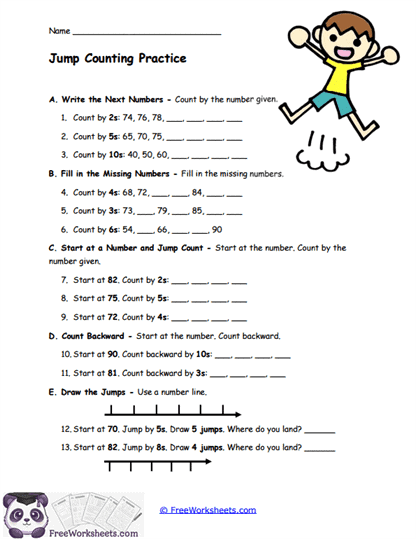
This worksheet brings movement into math by having students “jump” through numbers. It focuses on counting forward, skip counting, and even counting backward. For first graders, this kind of practice helps make number patterns more active and engaging. Instead of just writing numbers, they imagine jumping along a number line. It’s a fun way to build strong counting skills.
Curriculum and Grade Alignment
This worksheet supports Grade 1 math skills in counting and number patterns. The goal is to help students count by different amounts and understand how numbers change. Students should already be comfortable counting by ones before trying skip counting. It aligns with Common Core Standard 1.NBT.A.1, focusing on counting within 100. In TEKS, it connects with 1.2(A) for number relationships and patterns.
Student Tasks
Students work through several types of counting activities. They fill in missing numbers when counting by 2s, 5s, or 10s. They also practice counting forward and backward from a given number. In one section, they imagine jumping along a number line and figure out where they land. This variety keeps the activity interesting while building strong skills.
Common Challenges and Misconceptions
Skip counting can be tricky, especially when students are just learning patterns like counting by 5s or 10s. Some may lose track or accidentally switch patterns. Others might struggle with counting backward from larger numbers. Breaking the counting into small steps and saying numbers aloud can really help.
Implementation Guidance
This worksheet is great for a math lesson focused on number patterns or review. Teachers can model one type of counting before students try it on their own. It also works well in small groups where students can practice together. At home, parents can turn it into a fun counting game by “jumping” through numbers out loud.
Details and Features
The worksheet includes multiple sections with different counting challenges. It mixes forward, backward, and skip counting for variety. The layout is organized and easy to follow. It encourages active thinking instead of simple memorization. It prints clearly and is easy to use in any classroom setting.