
About This Worksheet
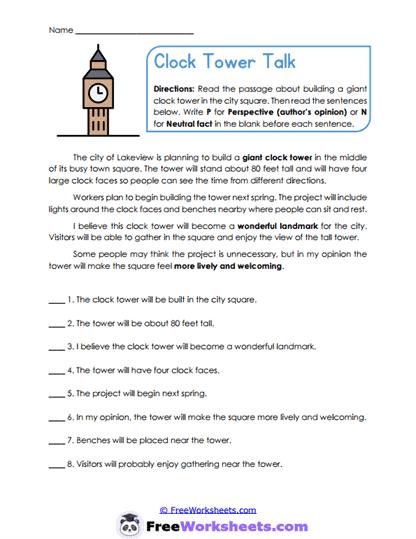
This worksheet is a reading comprehension and analysis activity that focuses on identifying an author’s perspective versus factual information in an informational passage. It is designed for Grade 4 students developing critical literacy skills, particularly in distinguishing objective details from subjective viewpoints. The passage describes a proposed clock tower project and blends measurable facts with personal opinions about its impact on the community. For example, “The tower will stand about 80 feet tall” becomes a fact, while “the project will make the square more lively and welcoming” reflects perspective. Students learn to analyze how language reveals author intent and stance.
Curriculum and Grade Alignment
This worksheet aligns with Grade 4 English Language Arts standards emphasizing analysis of text structure, author’s perspective, and evidence-based reasoning. The primary objective is for students to differentiate between verifiable information and opinion-based statements within informational text. Students should already be able to read and comprehend grade-level passages and identify basic sentence meaning. The next instructional step involves evaluating arguments and identifying bias in more complex texts. It aligns with CCSS.ELA-LITERACY.RI.4.6 and RI.4.8, as well as TEKS 4.6.G and 4.6.H, which focus on author’s purpose and distinguishing fact from opinion.
Student Tasks
On this worksheet, students will read a detailed passage about a proposed city clock tower project and analyze each statement carefully. They will categorize sentences as either perspective (author’s opinion) or neutral fact by writing P or N in the blanks provided. Students must refer back to specific wording in the text to justify their choices and support their reasoning. Several statements require close attention to subtle opinion cues such as “I believe” or “in my opinion.” This task promotes active reading, annotation, and evidence-based thinking.
Common Challenges and Misconceptions
Students often assume that all statements in informational passages are factual, especially when they contain specific details or formal language. Some learners may struggle to recognize opinion indicators when they are embedded within longer sentences. Others may misclassify predictive statements, such as what “will” happen, as facts instead of perspective. Confusion can also arise when opinions are presented confidently or positively. Teachers should explicitly model how to identify signal phrases and guide students in distinguishing between measurable facts and interpretive claims.
Implementation Guidance
Educators can incorporate this worksheet into a larger unit on author’s purpose, opinion writing, or informational text analysis. It works effectively as guided practice following a mini-lesson on identifying perspective versus fact. In classroom settings, students can collaborate in pairs or small groups to discuss and defend their answers, fostering academic discourse. Homeschool educators can use the worksheet as a structured reading activity paired with discussion questions about community planning and civic improvements. It also serves as a valuable formative assessment to gauge students’ analytical reading skills.
Details and Features
The worksheet includes a thoughtfully written passage that integrates both factual information and opinion-based statements about a real-world topic. Clear, student-friendly directions guide learners through the classification task. The layout provides numbered sentences with space for responses, supporting organization and clarity. It is designed for easy printing and use in both classroom and home environments. The content encourages critical thinking while remaining accessible to upper elementary learners.