
About This Worksheet
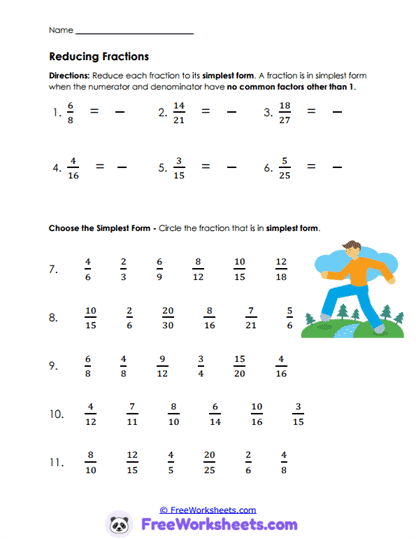
This worksheet teaches students how to reduce fractions to their simplest form. Simplifying fractions means rewriting a fraction so the numerator and denominator no longer share common factors other than one. Learners practice dividing both parts of the fraction by the same number to create an equivalent fraction in lowest terms. For example, 6/8 becomes 3/4 because both numbers can be divided by 2. This activity strengthens fraction reasoning and multiplication fact fluency.
Curriculum and Grade Alignment
This worksheet focuses on simplifying fractions and recognizing equivalent fraction relationships. Students should already understand basic fractions and common factors before beginning this activity. The main learning goal is helping learners reduce fractions accurately into simplest form. After mastering this skill, students are better prepared for adding, subtracting, and comparing fractions. The worksheet aligns with Common Core standard 5.NF.A.1 and TEKS 5.3B involving equivalent fractions and simplification.
Student Tasks
On this worksheet, students will
reduce fractions to their simplest form by dividing numerators and denominators by common factors. Students identify which fractions are already in simplest form and which need to be simplified further. Learners circle simplified fractions from groups of choices in the second section of the worksheet. Several problems encourage students to check their work carefully for remaining common factors. Students also practice recognizing equivalent fraction relationships.
Common Challenges and Misconceptions
Many students divide only the numerator or denominator instead of both numbers equally. Some learners stop simplifying too early before reaching the simplest form. Others may struggle to identify the greatest common factor between two numbers. Students can also become confused when fractions appear simplified but still share a common factor. Teachers can support understanding by reviewing multiplication facts and factor pairs before independent work.
Implementation Guidance
Teachers may use this worksheet during fraction units, review lessons, or intervention groups. The activity works well after introducing equivalent fractions and common factors. Parents and homeschool educators can guide students through one example at a time before independent completion. Fraction models may help visual learners understand why the simplified fractions still represent the same value. This worksheet also serves as strong preparation for fraction operations.
Details and Features
This printable worksheet includes fraction reduction problems and multiple-choice simplest-form practice. The layout is organized clearly so students can focus on solving one problem at a time. Friendly graphics help create an encouraging learning environment while maintaining academic focus. Problems are designed to strengthen both conceptual understanding and procedural fluency. The worksheet is suitable for classroom instruction, tutoring, or homeschool review.