
About This Worksheet
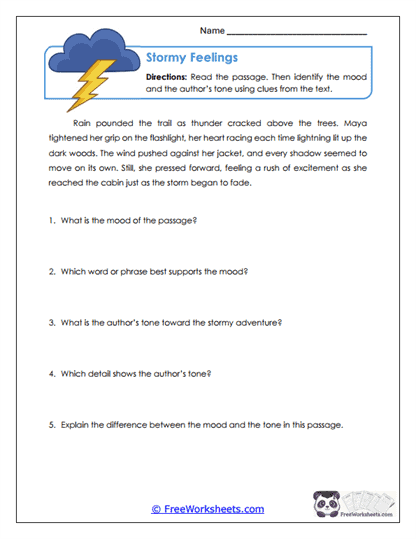
Mood and tone analysis is a literary skill that requires students to distinguish between the atmosphere of a story and the author’s attitude. This Grade 5 worksheet focuses on interpreting descriptive language within a narrative passage about a storm. Students identify the mood created by the setting and determine the author’s tone toward the adventure. For example, pounding rain creates tension while excitement reveals a positive tone.
Curriculum and Grade Alignment
This worksheet is designed for Grade 5 students analyzing literary elements in fiction. Students should already understand descriptive language and character emotions. The next progression involves comparing how different authors create mood and tone across texts. It aligns with Common Core Standard RL.5.4, which requires determining the meaning of words and phrases as they are used in a text. It also supports TEKS 5.7(A), focusing on analyzing how authors use language to convey mood and tone.
Student Tasks
On this worksheet, students will read a short narrative about a stormy night adventure. They will identify the mood of the passage and select words or phrases that support their answer. Learners analyze the author’s tone and cite details that reveal the author’s attitude. The final question requires students to explain the difference between mood and tone using evidence from the text.
Common Challenges and Misconceptions
Students often confuse mood with tone, using the terms interchangeably. Some learners may describe the character’s feelings instead of the overall atmosphere. Others might identify mood correctly but fail to support their answer with textual evidence. Teachers can clarify that mood affects the reader, while tone reflects the author’s attitude.
Implementation Guidance
Teachers may use this worksheet during a literature unit focused on figurative language and descriptive writing. It works well after modeling how specific words influence reader emotions. Parents can guide discussion by asking how certain phrases make the scene feel. The worksheet provides meaningful practice for literary analysis before assessments.
Details and Features
The worksheet includes a vivid narrative passage with strong descriptive language. Five comprehension questions guide students through analyzing mood and tone. Response spaces allow for detailed written explanations. The layout is clean, printable, and suitable for classroom or homeschool use.