
About This Worksheet
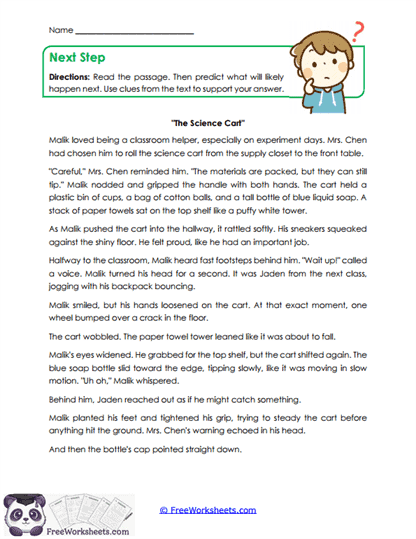
This worksheet is a prediction and inference activity designed to strengthen students’ ability to use textual evidence to anticipate outcomes. Students read a suspenseful narrative passage about Malik pushing a science cart and noticing potential problems. The story ends at a critical moment, requiring students to predict what will likely happen next. Rather than guessing randomly, students must use clues from the text to support their prediction. For example, they analyze earlier hints about tipping materials and the shifting bottle. This structured format builds advanced inferencing and evidence-based reasoning skills.
Curriculum and Grade Alignment
This worksheet aligns with Common Core Standard RL.4.1, which requires students to refer to specific details when making inferences. It also supports RL.4.3 by analyzing how character actions influence events. The focus on prediction increases cognitive rigor because students must synthesize multiple clues. Learners practice identifying foreshadowing and cause-and-effect relationships. This resource strengthens analytical thinking and close reading skills.
Student Tasks
Students read the passage carefully and identify key warning signs. They predict what will likely happen next in the story. Students must support their prediction with evidence from the text. Careful rereading ensures their reasoning is grounded in specific clues. The task promotes logical thinking and structured written explanations.
Common Challenges and Misconceptions
Students may make predictions without citing evidence. Some learners might guess outcomes unrelated to textual clues. Others may overlook earlier foreshadowing details. Confusion can arise when multiple possible outcomes seem likely. Teachers can model identifying cause-and-effect hints in the passage. Highlighting descriptive warnings strengthens inference accuracy.
Implementation Guidance
Teachers can use this worksheet during units on inference and prediction. It works well in small groups focused on identifying foreshadowing. Class discussions can compare different predictions and evaluate supporting evidence. Parents and homeschool educators may use this worksheet to reinforce close reading habits. Encourage students to underline textual clues before writing. This activity prepares students for higher-level inferential comprehension tasks.
Details and Features
The worksheet includes a suspenseful narrative passage. Open-ended responses require evidence-supported prediction. The layout supports organized written reasoning. The black-and-white printable format ensures classroom efficiency. The activity strengthens inference and analytical skills. Its design reinforces evidence-based prediction strategies.