
About This Worksheet
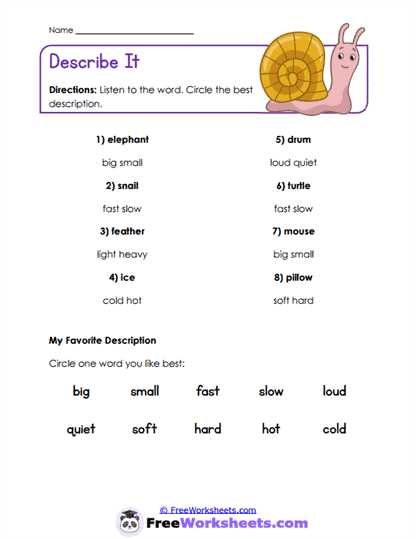
Describe It is a preschool vocabulary worksheet designed to strengthen understanding of descriptive words through comparison. At this developmental stage, children are building awareness of opposites and contrasting attributes such as big/small, fast/slow, and hot/cold. This worksheet helps students connect descriptive vocabulary to familiar objects and animals, reinforcing meaning through choice and repetition. By selecting the best description for each word, children practice semantic reasoning and deepen their vocabulary knowledge.
This activity also supports cognitive flexibility, as students must consider which adjective accurately matches the noun provided. Instead of memorizing adjectives in isolation, learners evaluate meaning within context. The inclusion of a “My Favorite Description” section encourages personal engagement and expressive language use.
Curriculum and Grade Alignment
This worksheet aligns with Preschool language development standards focused on describing objects, identifying attributes, and understanding opposites. It supports early readiness for Kindergarten standards involving vocabulary acquisition and describing familiar people, places, and things (Common Core L.K.5 readiness skills). It also aligns with TEKS Prekindergarten ELAR objectives related to vocabulary growth and comprehension. The worksheet reinforces attribute-based word learning in developmentally appropriate ways.
Student Tasks
Students listen to each noun (such as elephant or feather) and circle the adjective that best describes it. They evaluate contrasting word pairs and select the most accurate description. In the final section, they choose a favorite descriptive word and circle it. This encourages reflection and expressive vocabulary use.
Common Challenges and Misconceptions
Some preschoolers may rely on personal experiences that conflict with general knowledge (for example, thinking ice can be hot because of sun exposure). Others may choose answers randomly if they do not fully understand the adjective pair. Teachers should model thinking aloud when comparing options. Visual examples and discussion can strengthen understanding of abstract contrasts.
Implementation Guidance
This worksheet works well during small-group vocabulary instruction or attribute-focused lessons. Teachers can bring real objects into the classroom to demonstrate descriptive contrasts. Encouraging students to use the descriptive words in complete sentences deepens understanding. Parents can reinforce learning by describing objects around the home using opposite word pairs.
Details and Features
The worksheet includes eight noun-and-adjective comparison items with clear formatting. Opposite word pairs are developmentally appropriate and familiar to preschool learners. A personal reflection section promotes engagement and expressive language practice. The layout is simple and visually accessible for early learners.