
About This Worksheet
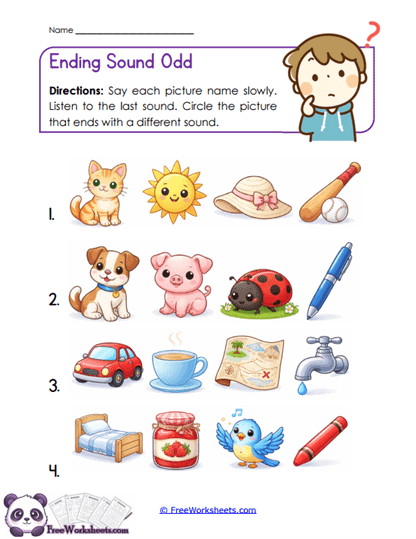
This worksheet is a phonemic awareness activity focused on identifying ending sounds and recognizing differences between them. It is designed for preschool learners developing listening and sound discrimination skills. Students compare groups of words and determine which one ends with a different sound. For example, “cat, hat, sun” leads to “sun” as the odd one out because it does not end with /t/. This activity strengthens the ability to isolate and compare final phonemes.
Curriculum and Grade Alignment
This worksheet aligns with preschool phonological awareness standards related to ending sound identification. The primary goal is to help students distinguish between similar and different final sounds in words. Students should already be able to recognize and pronounce simple words clearly. This skill supports later decoding and spelling development. It aligns with CCSS.ELA-LITERACY.RF.K.2.D and TEKS Pre-K phonological awareness outcomes.
Student Tasks
On this worksheet, students will say the name of each picture in a group. They listen carefully to the ending sound of each word. Learners identify which picture does not share the same final sound. They circle the image that is different from the others. This reinforces careful listening and sound comparison skills.
Common Challenges and Misconceptions
Students may focus on beginning sounds instead of ending sounds. Some might mispronounce words and incorrectly identify the final phoneme. Others may choose based on visual differences rather than sound. There can also be confusion when sounds are similar. Teachers should model how to stretch the end of each word to hear the final sound clearly.
Implementation Guidance
Teachers can use this worksheet during phonics instruction or as a review activity. It works well for small group practice or independent work. Parents can use it at home to reinforce listening and comparison skills. Encouraging students to say each word aloud improves accuracy. This activity supports early reading readiness.
Details and Features
The worksheet includes multiple sets of picture groups for comparison. It uses a simple circling format to show answers. Images are clear and engaging for young learners. The layout is easy to follow and age-appropriate. It is designed for printing and repeated classroom use.