
About This Worksheet
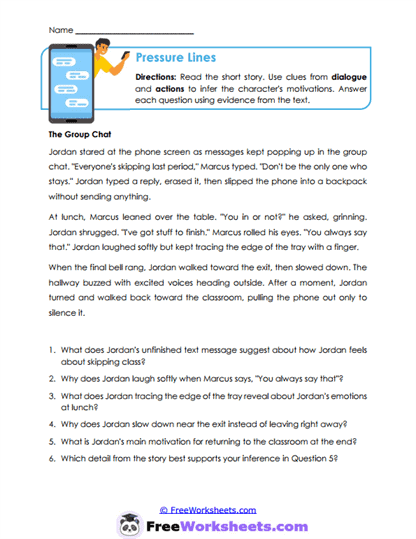
Pressure Lines is a grade 8 narrative reading worksheet focused on making inferences using dialogue and character actions. It is an upper middle school literacy resource that strengthens students’ ability to analyze motivation and internal conflict. The short story centers on a student facing peer pressure in a group chat. For example, an unfinished text message becomes evidence of hesitation. This worksheet develops students’ ability to draw conclusions supported by textual details.
Curriculum and Grade Alignment
This worksheet is designed for Grade 8 and emphasizes citing evidence to support inferences in literary texts. The primary learning goal is to analyze how dialogue and actions reveal character motivation. Students should already understand how to identify explicit details before making inferences. The next progression skill involves analyzing how character choices develop theme. This resource aligns with CCSS.ELA-LITERACY.RL.8.1, which requires citing strong textual evidence to support analysis.
Student Tasks
On this worksheet, students will read a short fictional narrative about peer pressure. They answer questions that require inferring how the main character feels. Learners analyze specific dialogue and actions for clues about motivation. Students explain why the character makes a final decision. Each response must reference evidence directly from the text.
Common Challenges and Misconceptions
Students may rely on personal experience rather than textual evidence when making inferences. Some learners might summarize events instead of explaining character motivation. Others may overlook subtle clues in body language or dialogue. Distinguishing between explicit and implied meaning can be difficult. Teachers can model highlighting evidence that supports each inference.
Implementation Guidance
Teachers can use this worksheet during a unit on character analysis or peer influence themes. It works well as guided practice before independent literary analysis writing. In small groups, students can discuss multiple interpretations of the character’s decision. Homeschool educators may read the story aloud and pause to discuss inference questions. The worksheet supports close reading and analytical reasoning.
Details and Features
The worksheet includes a short narrative passage followed by text-dependent questions. Prompts require evidence-based explanations rather than simple recall. The layout provides space for complete written responses. The printable design is suitable for classroom or home instruction. The relatable scenario increases student engagement.