
About This Worksheet
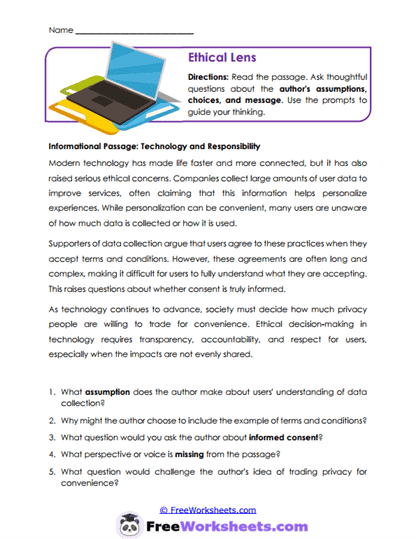
Ethical Lens is a grade 8 informational reading worksheet focused on analyzing author’s assumptions, perspective, and message. It is an upper middle school literacy resource that encourages critical thinking about technology and data privacy. The passage explores how companies collect user data and questions whether consent is truly informed. For example, long terms and conditions become evidence that users may not fully understand agreements. This worksheet strengthens students’ ability to evaluate underlying assumptions and consider missing perspectives.
Curriculum and Grade Alignment
This worksheet is designed for Grade 8 and emphasizes analyzing author’s point of view and reasoning in informational texts. The primary learning goal is to identify assumptions and evaluate how they shape the author’s message. Students should already understand how to determine central ideas before analyzing deeper implications. The next progression skill involves evaluating how authors acknowledge or omit alternative perspectives. This resource aligns with CCSS.ELA-LITERACY.RI.8.6, which focuses on determining an author’s point of view and analyzing how it is conveyed.
Student Tasks
On this worksheet, students will read an informational passage about technology and data collection. They identify assumptions the author makes about users’ understanding of privacy agreements. Learners analyze why the author includes specific examples, such as terms and conditions. Students consider which perspectives may be missing from the text. Each response requires thoughtful analysis supported by textual evidence.
Common Challenges and Misconceptions
Students may confuse assumptions with explicitly stated claims. Some learners might summarize the passage instead of analyzing the author’s reasoning. Others may struggle to identify perspectives that are implied but not directly presented. Distinguishing between opinion and analysis can also be challenging. Teachers can model asking critical questions about what the author includes and omits.
Implementation Guidance
Teachers can use this worksheet during a unit on media literacy or digital ethics. It works well as preparation for classroom discussions about privacy and responsibility. In small groups, students can debate whether consent online is truly informed. Homeschool educators may guide students through annotating assumptions in the text. The worksheet supports deeper analytical reasoning and critical evaluation skills.
Details and Features
The worksheet includes a focused informational passage with reflective, higher-level questions. Prompts encourage analysis beyond surface comprehension. The layout provides space for extended written responses. The printable format is classroom-ready and easy to distribute. The contemporary topic promotes engagement and thoughtful discussion.