
Grade 6 Worksheets
This worksheet collection is fully aligned with core curriculum standards across Language Arts, Math, Science, History/Social Studies, and Enrichment, supporting students as they transition into more rigorous middle school expectations. The materials strengthen analytical reading, evidence-based writing, mathematical reasoning, scientific literacy, and historical thinking while reinforcing executive function skills like organization and independent learning. Designed as a cohesive, curriculum-mapped system rather than isolated practice, the collection builds fluency, critical thinking, and academic confidence for success in Grade 7 and beyond.
About This Collection of Worksheets
This comprehensive Grade 6 Printable Worksheet Collection is intentionally designed to reflect the full scope of sixth-grade Core Curriculum standards across Language Arts, Mathematics, Science, History/Social Studies, and Enrichment domains. At this pivotal academic stage, students transition from upper elementary foundations into more advanced middle school expectations. Instruction becomes increasingly analytical, text-centered, evidence-based, and conceptually rigorous. This standards-aligned collection supports grade-level mastery by reinforcing foundational skills while building the fluency, independence, and academic confidence necessary for successful vertical alignment into Grade 7 and beyond.
In Language Arts, Grade 6 students are expected to engage deeply with complex texts, analyze author’s craft, cite textual evidence, and interpret literary and informational passages with increasing precision. They refine grammar usage, expand academic vocabulary, and strengthen structured writing skills across narrative, argumentative, and explanatory formats. Reading comprehension shifts from surface-level recall to critical analysis, including identifying themes, character development, central ideas, and figurative language. This collection supports conceptual understanding and literacy fluency by providing structured practice that encourages independent learning, close reading strategies, and thoughtful written responses aligned to grade-level standards.
In Mathematics, Grade 6 marks a significant expansion into ratios, proportional reasoning, fractions and decimals operations, introductory algebraic expressions, and statistical thinking. Students develop procedural fluency while strengthening mathematical reasoning and multi-step problem-solving skills. Conceptual understanding of number systems, integers, and rational numbers becomes central to academic progression. While this collection emphasizes literacy-based categories, its reading comprehension and analytical exercises reinforce mathematical reasoning by strengthening logical thinking, precision in interpreting word problems, and cross-curricular integration of quantitative reasoning within text analysis tasks.
In Science, students deepen their understanding of Life Science (cells, ecosystems, human body systems), Physical Science (forces, motion, energy), and Earth and Environmental Science (weather patterns, Earth’s systems, resource conservation). Sixth grade places strong emphasis on scientific inquiry-asking questions, analyzing data, drawing evidence-based conclusions, and interpreting informational texts. This collection supports scientific literacy by strengthening comprehension of complex nonfiction texts, academic vocabulary acquisition, and analytical reading skills essential for understanding science-based material. These competencies directly contribute to grade-level mastery in scientific reasoning and evidence-based writing.
In History and Social Studies, Grade 6 students explore ancient civilizations, early world cultures, geography, and foundational civics concepts. They are expected to analyze primary and secondary sources, evaluate cause-and-effect relationships, understand historical perspective, and interpret maps and timelines. The reading and literary analysis skills developed in this collection enhance historical thinking and cultural understanding by fostering critical evaluation of texts, contextual reasoning, and comparative analysis. This cross-curricular integration ensures students are prepared to engage with increasingly sophisticated historical content in middle school.
Beyond core academics, this collection supports Enrichment and Executive Function development, including critical thinking, logical reasoning, organization, sustained attention, and academic independence. Grade 6 learners are building greater responsibility for managing assignments and interpreting complex instructions. The structured yet rigorous format of these worksheets promotes self-directed learning, analytical reasoning, and intellectual resilience. By integrating literacy skills across disciplines, the collection fosters academic fluency and confidence while reinforcing the executive-function skills essential for long-term success.
Together, these materials reflect a full academic year of structured instruction aligned with Grade 6 standards. They are designed not as isolated practice sheets, but as a cohesive, curriculum-mapped system that strengthens foundational skills while preparing students for the academic demands of middle school. Through consistent practice, students build fluency, conceptual understanding, and the analytical sophistication required for the next stage of their educational journey.
A Look at the Categories of Worksheets
Grade 6 Reading Comprehension
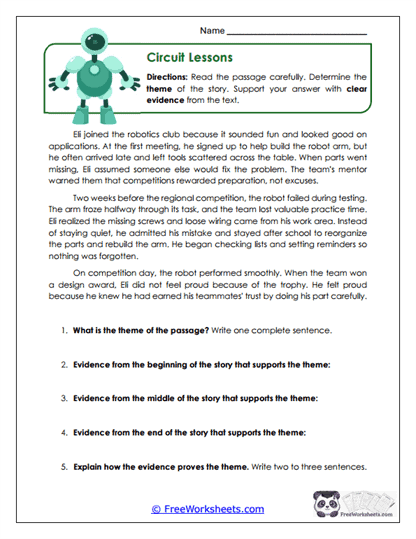
This category directly supports the Language Arts domain by strengthening close reading, textual analysis, and evidence-based reasoning skills aligned with Grade 6 standards. Students engage with literary and informational texts that require identifying central ideas, analyzing supporting details, drawing inferences, and citing textual evidence. These worksheets reinforce vocabulary development, comprehension fluency, and structured written responses that mirror classroom expectations and standardized assessments. By practicing higher-order thinking skills, students build academic confidence and develop the independent learning habits necessary for grade-level mastery and successful progression into middle school literacy demands.
Literary Devices
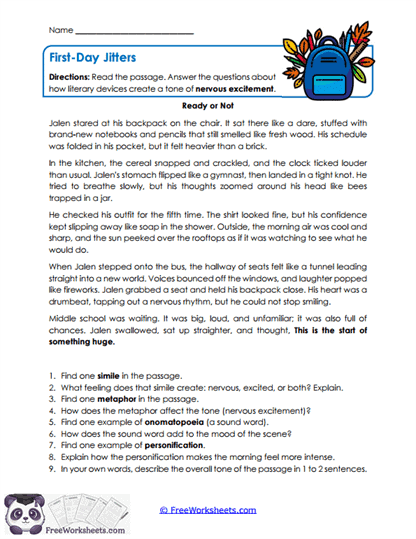
The Literary Devices worksheets focus on deepening students’ conceptual understanding of figurative language, symbolism, tone, mood, imagery, and other elements of author’s craft. Aligned with Grade 6 Language Arts standards, this category strengthens analytical reading and interpretive reasoning skills by guiding students to recognize how literary techniques shape meaning and theme. Students learn to analyze text structure and stylistic choices, supporting vertical alignment into more advanced literary analysis in upper middle school grades. This category enhances critical thinking, strengthens writing sophistication, and fosters cross-curricular integration by preparing students to interpret nuanced texts across literature, history, and science contexts.