
About This Worksheet
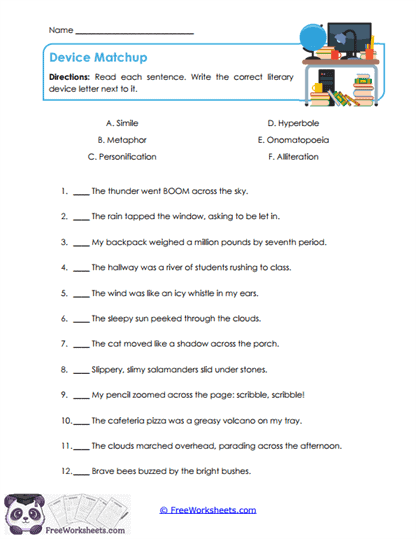
Literary device identification is a reading skill that requires students to recognize figurative and sound devices within individual sentences. This Grade 6 worksheet focuses on distinguishing between simile, metaphor, personification, hyperbole, onomatopoeia, and alliteration. Students analyze short sentences and match each to the correct literary term. For example, the thunder went boom demonstrates onomatopoeia because the word imitates a sound.
Curriculum and Grade Alignment
This worksheet is designed for Grade 6 students building mastery of multiple literary devices. Students should already understand basic comparisons such as similes and metaphors. The next progression involves analyzing how authors use multiple devices together to create tone and imagery. It aligns with Common Core Standard RL.6.4, which requires analyzing the impact of specific word choices on meaning and tone. It also supports TEKS 6.8(A), focusing on understanding figurative language and sound devices in literature.
Student Tasks
On this worksheet, students will read twelve individual sentences containing various literary devices. They will select the correct term from a provided list and write the matching letter beside each sentence. Learners must carefully analyze clues such as comparison words, exaggerated language, or sound words. The activity requires precise identification rather than general guessing.
Common Challenges and Misconceptions
Students may confuse metaphor and simile when comparisons are implied rather than explicit. Some learners might mistake hyperbole for metaphor because both can be exaggerated. Others may overlook alliteration if they focus only on meaning instead of sound patterns. Teachers can encourage students to underline key clue words before selecting an answer.
Implementation Guidance
Teachers can use this worksheet as practice after introducing or reviewing literary devices. It works well as a quick formative assessment to check understanding. Parents and homeschool educators may use it for review before a quiz on figurative language. The activity supports reinforcement of terminology and close reading skills.
Details and Features
The worksheet includes a clearly organized list of six literary device options. Twelve numbered sentences provide varied examples of figurative and sound techniques. The matching format allows for quick completion and easy grading. The printable design is classroom-friendly and straightforward to distribute.