
About This Worksheet
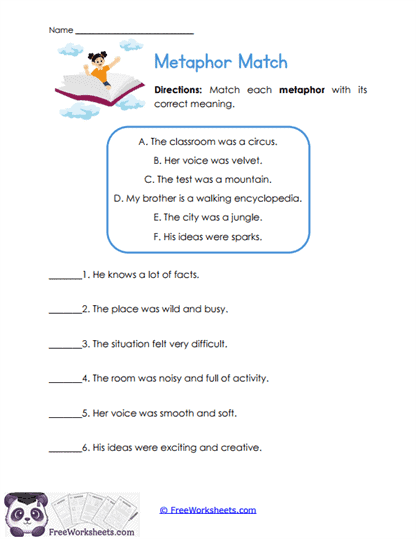
This worksheet is a figurative language activity focused on understanding metaphors and matching them to their correct meanings. It is designed for Grade 4 students and helps build comprehension of nonliteral language through clear examples. Students analyze metaphors and connect each one to a realistic interpretation. For example, saying “the classroom was a circus” becomes understanding that the room was noisy and full of activity.
Curriculum and Grade Alignment
This worksheet aligns with Grade 4 standards for interpreting figurative language in context. The primary learning goal is to help students recognize metaphors and understand what they mean beyond literal interpretation. Students should already be familiar with basic figurative language concepts before completing this activity successfully. This supports CCSS.ELA-LITERACY.RL.4.4 and TEKS 4.8(A), which emphasize understanding figurative expressions.
Student Tasks
On this worksheet, students will read a set of metaphors and a list of meanings. They will match each metaphor with the correct explanation based on context and understanding. Learners must think about how each comparison represents a deeper meaning. The activity encourages careful reading and interpretation of figurative language.
Common Challenges and Misconceptions
Students may interpret metaphors literally instead of recognizing their symbolic meaning. Some learners might confuse metaphors with similes or other figurative language types. Others may struggle to connect abstract comparisons to real-life meanings. Teachers should model how to break down metaphors into understandable ideas.
Implementation Guidance
This worksheet is ideal for introducing or reinforcing metaphor concepts during a figurative language unit. Teachers can review examples together before assigning independent practice. Parents and homeschool educators can use this activity to build vocabulary and comprehension skills at home. It also works well as a warm-up or review activity.
Details and Features
The worksheet includes clear metaphor examples paired with structured answer choices. It supports both recognition and interpretation of figurative language. The layout is simple and easy for students to follow. It is designed for printing and flexible instructional use.