
About This Worksheet
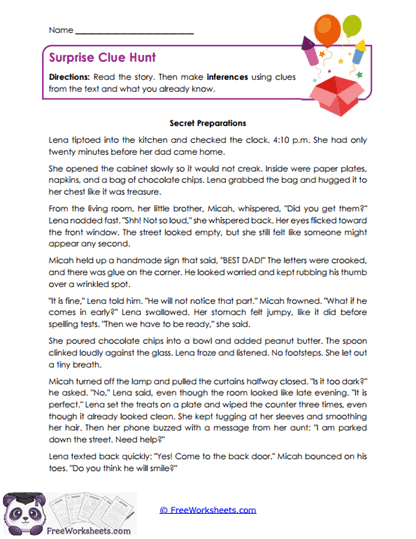
This worksheet is an inference-based reading comprehension activity focused on using text clues and background knowledge to understand a story. It is designed for Grade 4 students and emphasizes making logical conclusions from details. Students read about Lena preparing a surprise and infer what is happening based on clues. For example, gathering decorations and whispering plans becomes evidence that a surprise event is being prepared.
Curriculum and Grade Alignment
This worksheet aligns with Grade 4 standards for making inferences and supporting them with evidence from the text. The primary learning goal is to help students combine textual clues with prior knowledge to draw conclusions. Students should already be able to identify explicit details in a passage before completing this activity successfully. This supports CCSS.ELA-LITERACY.RL.4.1 and TEKS 4.6(F).
Student Tasks
On this worksheet, students will read a narrative passage about preparing a surprise. They will answer questions that require making inferences based on clues in the text. Learners must use both evidence and reasoning to support their answers. The activity encourages critical thinking and deeper comprehension.
Common Challenges and Misconceptions
Students may rely only on prior knowledge without using evidence from the text to support their inferences. Some learners might struggle to identify which details are important clues. Others may provide answers that are not clearly supported by the passage. Teachers should emphasize using both text evidence and logical reasoning.
Implementation Guidance
This worksheet is ideal for teaching inference skills during reading comprehension lessons. Teachers can model how to combine clues with prior knowledge before assigning independent work. Parents and homeschool educators can use this activity to strengthen reasoning skills at home. It also works well as a discussion-based activity.
Details and Features
The worksheet includes a detailed narrative passage with subtle clues that encourage inference. It features structured questions that guide students toward thoughtful responses. The layout is clear and easy for students to follow. It is designed for printing and flexible instructional use.