
About This Worksheet
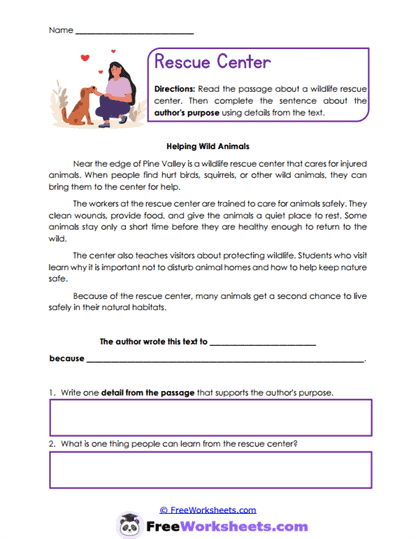
This worksheet is a reading comprehension activity focused on identifying the author’s purpose using supporting details from an informational text. It is designed for Grade 4 students within the English Language Arts curriculum and emphasizes understanding how authors communicate intent through factual writing. Students read a passage about a wildlife rescue center and determine why the author wrote the text using evidence. For example, describing how animals are cared for becomes evidence that the purpose is to inform readers about real-world practices.
Curriculum and Grade Alignment
This worksheet aligns with Grade 4 standards for analyzing informational texts and identifying the author’s purpose using textual evidence. The primary learning goal is to help students distinguish informational writing from other types such as persuasive or entertaining texts. Students should already be able to identify main ideas and supporting details before completing this task successfully. This supports CCSS.ELA-LITERACY.RI.4.6 and TEKS 4.6(G), which emphasize understanding author’s intent and purpose in nonfiction texts.
Student Tasks
On this worksheet, students will read an informational passage about a wildlife rescue center that helps injured animals recover safely. They will complete a sentence identifying the author’s purpose and explain their reasoning using details from the text. Learners must also write one specific piece of evidence that supports their conclusion about the author’s intent. Additionally, students answer a comprehension question about what people can learn from visiting the rescue center.
Common Challenges and Misconceptions
Students may confuse interesting or emotional details in the passage with persuasive intent instead of recognizing that the text is primarily informational. Some learners might struggle to clearly explain their reasoning using complete sentences and relevant evidence from the passage. Others may provide vague or unrelated details that do not directly support the identified purpose. Teachers should model how to select precise evidence and connect it clearly to the author’s purpose.
Implementation Guidance
This worksheet works well as part of a guided reading lesson focused on informational texts and author’s purpose analysis. Teachers can introduce the concept with examples before assigning the worksheet for independent or small group practice. Parents and homeschool educators can use this activity to reinforce comprehension skills and encourage thoughtful written responses. It also serves as an effective formative assessment to evaluate students’ ability to connect evidence with purpose.
Details and Features
The worksheet includes a clearly written nonfiction passage with age-appropriate vocabulary and engaging content about wildlife rescue efforts. It provides structured response prompts that guide students to write complete and thoughtful answers. The layout is clean and visually accessible, making it easy for students to follow along and complete tasks independently. It is designed for convenient printing and repeated classroom or home use.