
About This Worksheet
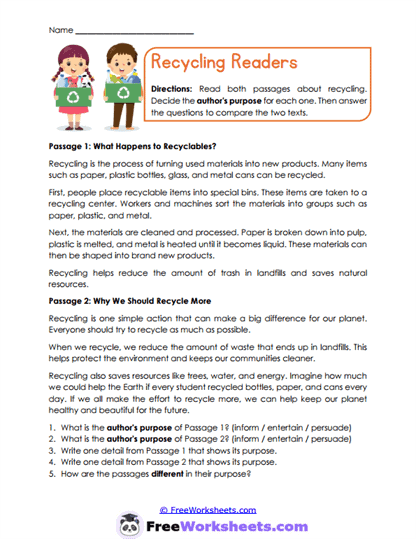
This worksheet is a comparative reading activity that focuses on identifying author’s purpose across multiple texts. It is designed for Grade 4 students in English Language Arts. Learners read two passages about recycling and determine each author’s purpose. For example, a process explanation becomes “inform,” while a call to action becomes “persuade.”
Curriculum and Grade Alignment
The worksheet aligns with Grade 4 standards for comparing texts and analyzing purpose. The primary goal is to help students distinguish between informational and persuasive writing. Students should already be able to identify main ideas and details. This supports CCSS.ELA-LITERACY.RI.4.6 and RI.4.9, as well as TEKS 4.6(G).
Student Tasks
On this worksheet, students will read two passages about recycling. They will determine the author’s purpose for each passage. Learners answer questions comparing the texts and identifying supporting details. Students also explain how the purposes differ between passages.
Common Challenges and Misconceptions
Students may assume both passages have the same purpose due to shared topics. Some may struggle to find specific details that support their answers. Others might confuse explanation with persuasion. Teachers should guide students in comparing tone and intent between texts.
Implementation Guidance
This worksheet is useful for paired reading or group analysis. Teachers can model comparing texts before assigning independent work. Parents can support by discussing differences in tone and message. It also works well as an assessment of higher-level comprehension skills.
Details and Features
The worksheet includes two structured passages and multiple comprehension questions. It encourages analytical thinking and comparison skills. The format is clear and easy to follow for students. It is designed for print and classroom distribution.