
About This Worksheet
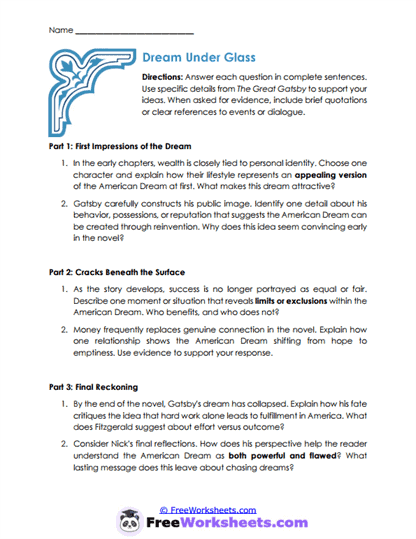
Dream Under Glass is a grade 12 literary analysis worksheet centered on The Great Gatsby. It is a high school senior-level resource designed to guide students through a layered examination of the American Dream as it appears idealized, distorted, and ultimately dismantled in the novel. The worksheet moves chronologically through Gatsby’s arc-first impressions, emerging cracks, and final reckoning-mirroring Fitzgerald’s structural development of illusion and disillusionment.
Students are asked not only to interpret Gatsby’s dream but to evaluate how Fitzgerald constructs its appeal and exposes its fragility. The questions emphasize symbolism, characterization, social critique, and thematic complexity. This worksheet pushes students toward interpretive depth, requiring textual evidence in the form of brief quotations or clear references to dialogue and events.
Curriculum and Grade Alignment
This worksheet is designed for Grade 12 and emphasizes advanced literary analysis, theme development, and critical interpretation of symbolism and social commentary. The primary learning goal is to analyze how Fitzgerald develops the American Dream as both alluring and corruptible. Students should already be proficient in citing textual evidence and analyzing character motivation.
The next progression skill involves writing extended literary analysis essays that examine thematic complexity and historical context. This resource aligns with CCSS.ELA-LITERACY.RL.11-12.2, RL.11-12.3, and RL.11-12.5.
Student Tasks
Students analyze Gatsby’s early portrayal and identify how Fitzgerald initially frames his dream as appealing or aspirational. They examine details about Gatsby’s public persona and explain how reputation shapes early impressions.
In the second section, students identify moments that reveal cracks in the illusion-such as the unequal distribution of privilege or Daisy’s limitations as an object of idealization. They analyze how symbolism increasingly replaces genuine connection.
In the final section, students interpret Gatsby’s downfall as a critique of wealth, class mobility, and illusion. They consider Nick’s reflective perspective and evaluate the novel’s lasting message about ambition and moral cost.
Common Challenges and Misconceptions
Students may treat Gatsby purely as a romantic hero without examining Fitzgerald’s critique of materialism. Others may oversimplify the American Dream as entirely negative. Teachers can model close reading of key scenes such as the reunion with Daisy or the final funeral to demonstrate tonal shifts.
Implementation Guidance
This worksheet works well near the conclusion of a Great Gatsby unit. It can serve as a discussion guide before a summative essay. Teachers may extend the activity by having students compare Gatsby’s dream to contemporary interpretations of success.
Details and Features
The worksheet is organized into three thematic sections reflecting narrative progression. Prompts require complete sentences and textual evidence. The structure supports paragraph-length analytical responses aligned with senior-level expectations.