
About This Worksheet
Burning Images is a Grade 12 literary analysis worksheet centered on Ray Bradbury’s Fahrenheit 451. It is designed as a senior-level resource that pushes students beyond identifying symbols and into evaluating how imagery and metaphor operate as sustained social critique. The worksheet focuses specifically on Bradbury’s recurring fire imagery and technological metaphors, asking students to analyze how these devices evolve over the course of the novel.
Rather than treating fire as a simple symbol of destruction, students are guided to trace its shifting meaning-from spectacle and censorship to purification and renewal. The worksheet also directs attention to mechanical imagery (such as the Mechanical Hound and wall-sized televisions) as representations of dehumanization and passive conformity. Students must support their interpretations with brief quotations or clear references to events, reinforcing evidence-based analysis at an advanced level.
Curriculum and Grade Alignment
This worksheet is designed for Grade 12 and emphasizes symbolic development, figurative language analysis, and thematic synthesis. The primary learning goal is to evaluate how Bradbury uses imagery and metaphor to critique censorship, anti-intellectualism, and societal complacency.
Students should already be proficient in identifying literary devices and analyzing theme. The next progression skill involves writing extended essays that trace symbolic patterns across an entire text. This resource aligns with CCSS.ELA-LITERACY.RL.11-12.2, RL.11-12.4, and RL.11-12.5.
Student Tasks
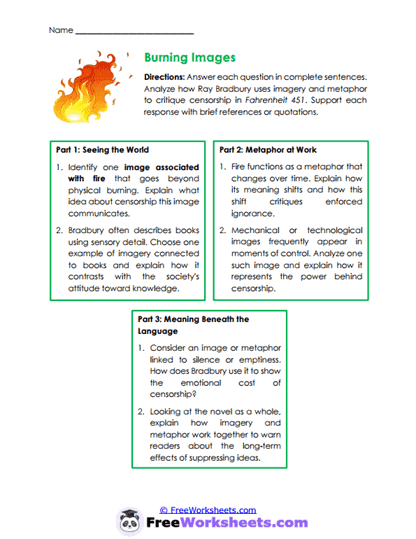
Students first identify an image associated with fire that extends beyond literal flames and analyze how it comments on censorship. They then examine Bradbury’s sensory description of books to explain how imagery contrasts destruction with knowledge.
In the second section, students analyze fire as a metaphor whose meaning shifts over time, explaining how its transformation critiques enforced ignorance. They also evaluate how mechanical imagery reinforces themes of control and suppression.
In the final section, students synthesize their analysis by explaining how imagery and metaphor together warn readers about the long-term consequences of suppressing ideas. Responses require precise textual references and interpretive depth.
Common Challenges and Misconceptions
Students may treat fire as a static symbol rather than one that evolves. Others may summarize events instead of analyzing figurative language. Teachers can model how to track a symbol’s development across multiple chapters.
Implementation Guidance
This worksheet works best after students have completed the novel. It can serve as a pre-writing organizer for a thematic analysis essay on censorship or knowledge.
Details and Features
The worksheet is divided into three structured sections: imagery identification, metaphor analysis, and thematic synthesis. Prompts require complete sentences and textual support. The format supports extended senior-level analytical responses.