
About This Worksheet
Voting Voices Audit is a grade 11 editorial analysis worksheet focused on identifying claims, evaluating evidence, and detecting reasoning gaps. It is a high school literacy resource that strengthens students’ ability to analyze persuasive writing critically. The editorial examines arguments for lowering the voting age to sixteen. For example, it presents evidence about civic engagement habits while acknowledging counterarguments about maturity. This worksheet builds advanced argumentative evaluation skills by asking students to assess evidence strength and logical flow.
Curriculum and Grade Alignment
This worksheet is designed for Grade 11 and emphasizes evaluating claims and reasoning in persuasive texts. The primary learning goal is to distinguish strong evidence from weaker reasoning and identify gaps. Students should already understand how to identify claims before evaluating support. The next progression skill involves writing analytical essays critiquing argument structure. This resource aligns with CCSS.ELA-LITERACY.RI.11-12.8.
Student Tasks
Students identify two major claims presented in the editorial. They evaluate the strength of evidence for each claim, determining whether it is strong, moderate, or weak. Learners identify at least one reasoning gap or unanswered question. Finally, they analyze whether the conclusion logically follows from earlier claims. Each response requires citation and explanation.
Common Challenges and Misconceptions
Students may confuse opinion with evidence. Some learners might accept statistics without evaluating their relevance. Others may struggle to explain reasoning gaps clearly. Teachers can model analyzing claim-evidence relationships step by step.
Implementation Guidance
This worksheet works well in government or rhetoric units. Teachers can extend the lesson by having students draft rebuttals or alternative conclusions. The activity promotes critical evaluation of civic debates.
Details and Features
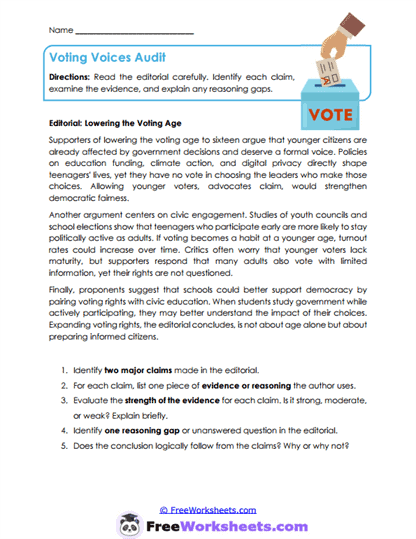
The worksheet includes an editorial passage and five structured analysis questions. Prompts require evaluation and reasoning explanation. The layout supports extended responses.