
About This Worksheet
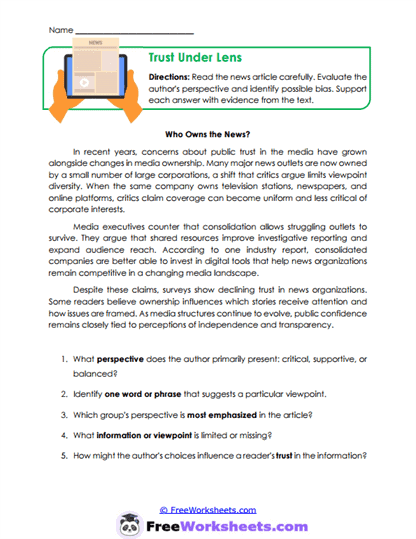
Trust Under Lens is a grade 11 informational reading worksheet focused on analyzing perspective, emphasis, and credibility in a news-style article. It is a high school literacy resource designed to strengthen students’ ability to determine whether a text presents a critical, supportive, or balanced viewpoint. The article, Who Owns the News?, examines media consolidation and public trust, presenting both critics’ concerns and industry defenses. For example, critics argue that ownership limits viewpoint diversity, while media executives claim consolidation improves investigative reporting and technological investment. This worksheet builds advanced evaluation skills by requiring students to weigh emphasis, detect perspective, and consider how framing influences trust.
Curriculum and Grade Alignment
This worksheet is designed for Grade 11 and emphasizes analyzing perspective and evaluating how an author develops a balanced or biased presentation. The primary learning goal is to determine which viewpoints are emphasized and how that emphasis shapes reader perception. Students should already understand how to identify claims and counterclaims before evaluating representation balance. The next progression skill involves writing analytical essays that critique media framing and credibility. This resource aligns with CCSS.ELA-LITERACY.RI.11-12.6 and RI.11-12.8.
Student Tasks
Students identify the primary perspective presented in the article-critical, supportive, or balanced-and support their choice with specific language from the text. Learners locate one word or phrase that signals a particular viewpoint. They analyze which group’s perspective receives the most attention and determine what information may be limited or omitted. Finally, students explain how framing and emphasis might affect public trust in media institutions. Each answer requires textual citation and evaluative reasoning.
Common Challenges and Misconceptions
Students may assume that presenting two sides automatically means the article is neutral. Some learners might overlook subtle framing language that privileges one perspective. Others may summarize content rather than analyzing emphasis. Teachers can model comparing paragraph length and tone devoted to each viewpoint.
Implementation Guidance
This worksheet works well in media literacy, journalism, or civics units. Teachers can extend the lesson by comparing this article to a clearly biased opinion piece. Class discussion can explore how ownership structures influence narrative framing. The activity strengthens critical consumption of news media.
Details and Features
The worksheet includes a structured informational article and five analytical questions. Prompts require evaluation of perspective and credibility. The layout supports extended written responses. The printable format is classroom-ready and suited for advanced comprehension practice.