
About This Worksheet
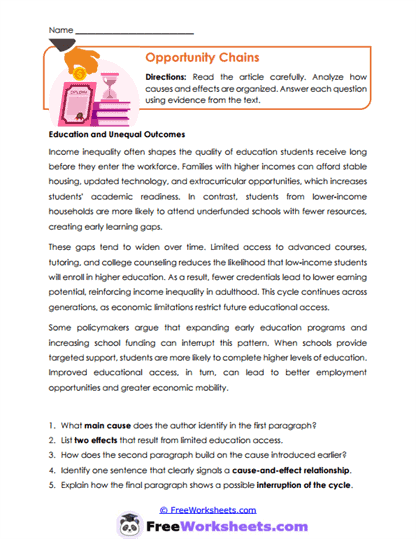
Opportunity Chains is a grade 11 informational reading worksheet focused on analyzing cause-and-effect relationships in social issues. It is a high school literacy resource designed to help students trace how inequality develops and how policy interventions may interrupt cycles. The passage explains how income inequality affects educational access and long-term economic mobility. For example, limited access to advanced courses can reduce college enrollment, reinforcing inequality. This worksheet builds advanced analytical skills in identifying interconnected causes and outcomes.
Curriculum and Grade Alignment
This worksheet is designed for Grade 11 and emphasizes analyzing cause-and-effect structures in informational texts. The primary learning goal is to explain how initial causes lead to extended consequences across generations. Students should already understand how to identify cause-and-effect relationships before completing this activity. This resource aligns with CCSS.ELA-LITERACY.RI.11-12.3.
Student Tasks
Students identify the main cause introduced in the first paragraph. They list effects that result from limited educational access. Learners explain how later paragraphs build on earlier causes. Students locate a sentence that explicitly signals a cause-and-effect relationship and explain how the final paragraph introduces a possible solution. Each answer must include textual evidence.
Common Challenges and Misconceptions
Students may confuse examples with causes. Some learners might list effects without tracing connections. Others may overlook signal words like “as a result.” Teachers can model mapping chains visually.
Implementation Guidance
This worksheet works well in social studies integration or economic policy units. Teachers can extend by having students create flowcharts of cause-and-effect chains. The activity strengthens analytical reasoning.
Details and Features
The worksheet includes a structured informational passage and five analysis questions. Prompts emphasize evidence-based explanation. The printable format supports classroom use.