
About This Worksheet
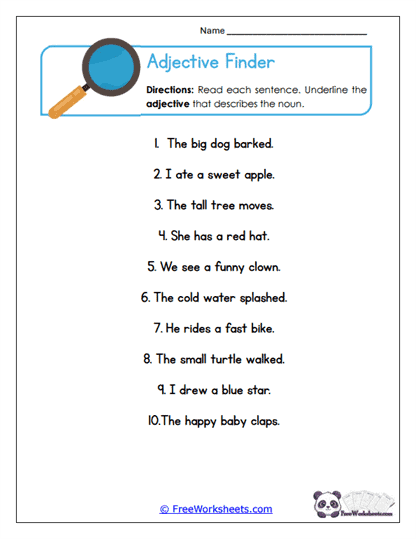
Adjective Finder builds on students’ understanding of nouns by introducing adjectives as describing words. Students read sentences and underline the adjective that describes the noun. Each sentence contains one clear adjective paired with a familiar noun. This structure helps students isolate descriptive language within meaningful context.
At the Grade 1 level, students are beginning to understand that words can add detail and make sentences more interesting. This worksheet makes that concept concrete. By underlining the adjective, students visually separate describing words from naming words. This reinforces grammar awareness while supporting reading comprehension.
The sentences are simple but engaging. Words like big, sweet, tall, red, funny, cold, and small provide accessible examples of descriptive language. The repetition builds confidence and clarity in identifying adjectives.
Curriculum and Grade Alignment
This worksheet aligns with Common Core L.1.1.f, which focuses on using frequently occurring adjectives. It also supports TEKS Grade 1 grammar objectives related to descriptive language. Students practice identifying adjectives in complete sentences.
Understanding adjectives strengthens writing development. Students learn that adding descriptive words improves clarity and detail.
Student Tasks
Students read ten short sentences. In each sentence, they underline the adjective describing the noun. They must correctly distinguish describing words from action words.
Students practice connecting adjectives to specific nouns. This reinforces sentence structure understanding.
Common Challenges and Misconceptions
Students may underline the noun instead of the adjective. Others may confuse verbs with adjectives. Teachers should model identifying the noun first, then asking which word describes it.
Visual color-coding can support understanding. Guided discussion improves accuracy.
Implementation Guidance
Teach nouns and adjectives together before assigning. Provide examples such as “The red apple” to demonstrate description. Encourage oral identification before writing.
Review answers as a class. Reinforce how adjectives make sentences more interesting.
Details and Features
Ten structured adjective-identification sentences.
Supports grammar and descriptive language development.
Encourages contextual understanding of modifiers.