
About This Worksheet
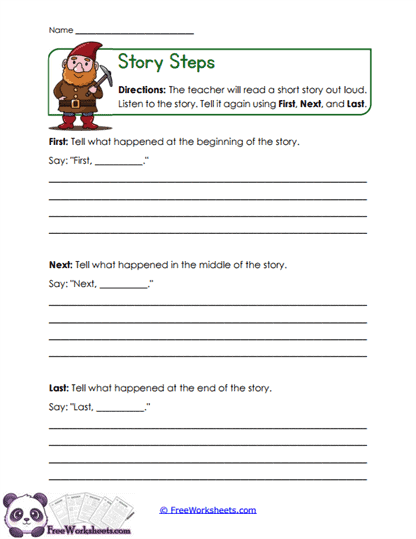
Story Steps is a Grade 1 listening comprehension worksheet focused on narrative sequencing and retelling skills. Students listen to a short story read aloud and then retell it using structured sequence words: First, Next, and Last. This activity strengthens comprehension, memory retention, and organized oral expression. By structuring retelling with clear transition words, students build foundational narrative skills.
Sequencing is a critical early literacy skill. Students must identify beginning, middle, and end events accurately. This worksheet helps them practice organizing story details logically. The structured prompts reduce cognitive overload while encouraging detailed responses.
Retelling stories improves both listening comprehension and expressive language. Students move from passive listening to active recall. This supports deeper understanding of narrative structure.
Curriculum and Grade Alignment
This worksheet aligns with Common Core SL.1.2, which requires students to recount key ideas and details from a text read aloud. It also supports RL.1.2, which focuses on retelling stories and demonstrating understanding of central message. In TEKS Grade 1 ELAR standards, it aligns with listening comprehension and narrative retelling objectives.
The use of transition words supports writing readiness standards as well. Students begin internalizing story structure language. This worksheet prepares them for independent story writing in later grades.
It is developmentally appropriate for Grade 1 students building structured retelling skills. It can be used as guided practice or independent comprehension assessment.
Student Tasks
Students listen carefully as the teacher reads a short story. They then complete three sections: First, Next, and Last. Each section requires a complete sentence describing that part of the story.
Students must focus on key events rather than minor details. This strengthens comprehension and prioritization skills. The writing lines encourage sentence formation and organization.
Common Challenges and Misconceptions
Some students may retell events out of order. Others may include unnecessary details. Teachers should emphasize chronological order before students begin writing.
Students may struggle with using transition words correctly. Modeling an example retell supports clarity. Providing sentence starters helps build confidence.
Implementation Guidance
Read the story aloud twice for support. After reading, briefly discuss major events before students write. Encourage students to orally rehearse their retell first.
This worksheet works well in guided reading groups. It also serves as a comprehension assessment tool. Pairing oral and written retelling strengthens retention.
Details and Features
Includes structured sections for beginning, middle, and end.
Encourages use of transition words.
Strengthens narrative organization and recall.
Designed for Grade 1 listening comprehension development.