
About This Worksheet
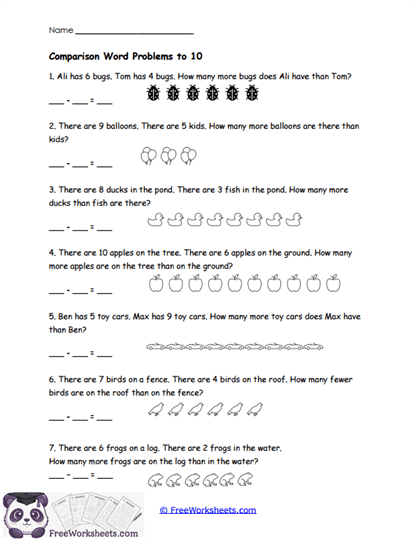
This worksheet is a beginning math comparison activity that helps students understand how to find the difference between two numbers up to 10. It focuses on early subtraction concepts within the context of simple word problems and visual supports. Designed primarily for kindergarten and first grade learners, it reinforces counting, number sense, and comparison vocabulary such as “more” and “fewer.” For example, 6 bugs compared to 4 bugs becomes 6 − 4 = 2.
Curriculum and Grade Alignment
This worksheet is appropriate for kindergarten and early first grade students who are developing foundational subtraction and comparison skills. The primary learning goal is to determine how many more or fewer items one group has than another within 10. Students should already be able to count objects accurately and recognize numerals to 10 before completing this activity. It aligns with Common Core standard K.OA.A.1 and K.OA.A.3, which focus on representing and solving addition and subtraction problems within 10, and supports TEKS K.3(H) involving comparisons of sets.
Student Tasks
On this worksheet, students will read short word problems that compare two quantities of objects such as bugs, balloons, ducks, or apples. They count the items or use the numbers provided to determine how many more or fewer items one group has. Each problem requires students to write a subtraction equation to match the comparison scenario. Learners then record the correct difference in the blank space provided.
Common Challenges and Misconceptions
Some students may confuse the meaning of “more” and “fewer,” leading them to subtract in the wrong order. Others might struggle to connect the visual images with the written numbers in the problem. It is also common for young learners to miscount small picture sets if they rush. Teachers can address these issues by modeling think-aloud strategies and reinforcing comparison vocabulary before independent work.
Implementation Guidance
Teachers can use this worksheet during a math centers rotation or as guided practice after introducing comparison word problems. It works well as formative assessment to check student understanding of subtraction within 10. Parents and homeschool educators may use it as structured practice after hands-on counting activities with real objects. Reviewing one example together before independent completion can increase student confidence and accuracy.
The worksheet includes clearly illustrated images to support early readers and visual learners. Each problem provides space for writing both a number sentence and the final answer. The layout is simple and uncluttered, making it easy to print and distribute in black and white. The format supports independent work while still allowing for teacher guidance.