
About This Worksheet
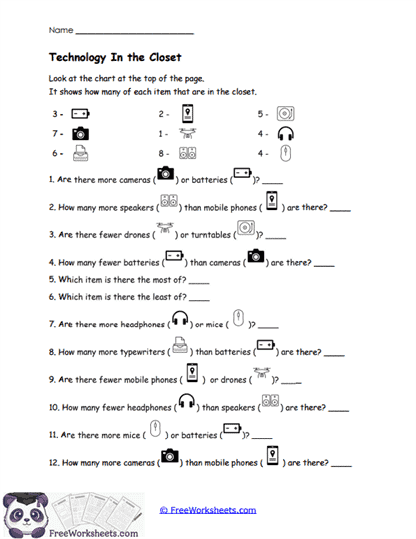
This worksheet is a real-world comparison and subtraction activity centered on a collection of technology items stored in a closet. Students analyze quantities of devices and determine how many more or fewer items appear in one category compared to another. Designed for first grade learners, it strengthens subtraction within 10 through applied data interpretation. The technology theme increases engagement by connecting math to familiar classroom or home environments. For example, 8 speakers and 3 phones becomes 8 − 3 = 5. This applied approach reinforces subtraction as a method for comparing quantities rather than simply taking away.
Curriculum and Grade Alignment
This resource aligns with first grade operations and algebraic thinking standards focused on solving subtraction word problems within 10. The primary learning goal is to develop fluency in comparing numerical quantities and calculating differences accurately. Students should already demonstrate basic subtraction fact knowledge and strong number sense before completing this worksheet. The content supports Common Core Standards 1.OA.A.1 and 1.OA.C.6, which emphasize solving and fluently computing subtraction problems. It also aligns with TEKS 1.3(B) and 1.3(D), addressing comparison reasoning and number relationships. This worksheet strengthens students’ ability to interpret simple data sets and apply subtraction strategically.
Student Tasks
On this worksheet, students will examine a chart or list that displays counts of various technology items such as laptops, tablets, speakers, or headphones. They read comparison questions that require identifying which category has more or fewer items. Students compute the difference between two quantities using subtraction within 10. Some prompts ask learners to determine which item appears most frequently or least frequently. Each response must be recorded clearly in the designated answer space. The tasks require careful reading, data interpretation, and accurate subtraction.
Common Challenges and Misconceptions
Students may misread the technology chart and confuse item categories. Some learners may subtract the numbers in the wrong order when determining differences. Others might identify the larger quantity but forget to calculate how many more it represents. Multi-step comparison questions can also challenge students who rush through the reading. Confusion between “most,” “least,” and “how many fewer” may result in incorrect answers. Teachers can model how to underline key information and set up subtraction equations clearly before solving.
Implementation Guidance
Teachers can use this worksheet during lessons that integrate math with real-world data interpretation. It works effectively as guided practice when reviewing subtraction within 10. Small-group instruction allows educators to reinforce comparison vocabulary and reasoning strategies. Parents and homeschool educators may incorporate this worksheet into applied math lessons that emphasize everyday problem solving. Reviewing one example problem together before independent work supports understanding. This resource also serves as a useful formative assessment for subtraction fluency.
Details and Features
The worksheet includes a clearly organized list or chart of technology items for easy reference. Questions are structured to promote both computational accuracy and analytical thinking. Ample space is provided for students to record answers neatly. The theme enhances engagement while maintaining academic rigor. The printable black-and-white format ensures easy classroom copying. Its consistent structure supports repeated use for skill reinforcement.