
About This Worksheet
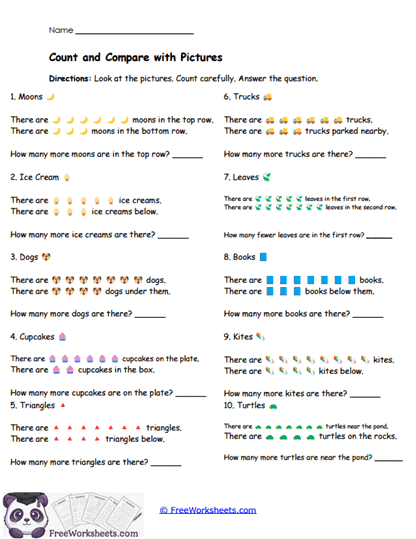
This worksheet is a visual comparison and subtraction activity designed to help students determine differences within 10. It focuses on strengthening number sense by requiring learners to count two sets of objects and identify how many more items are in one group. Created for kindergarten and first grade students, it supports early mathematical reasoning and comparison vocabulary development. Students move from concrete counting to abstract subtraction equations. For example, 8 books and 6 books becomes 8 − 6 = 2. This structure reinforces the concept that subtraction can represent finding the difference between two quantities rather than simply taking away.
Curriculum and Grade Alignment
This worksheet supports foundational operations and algebraic thinking standards in early elementary mathematics. The primary objective is for students to compare two quantities and accurately compute the difference within 10. Before completing this activity, learners should demonstrate consistent one-to-one correspondence and numeral recognition to 10. The content aligns with Common Core Standards K.OA.A.1 and 1.OA.A.1, which emphasize solving addition and subtraction word problems within 10. It also supports TEKS K.3(H) and 1.3(B), focusing on comparing sets and determining how many more or fewer. This resource builds readiness for more advanced subtraction strategies in later grades.
Student Tasks
On this worksheet, students will count two picture groups that may include objects such as trucks, leaves, kites, or school supplies. After determining the totals for each set, they compare the quantities to identify the larger group. Students then subtract to calculate how many more items are in the greater set. Each problem requires recording the final difference clearly in the provided answer space. Learners must interpret visual information before applying subtraction. The activity encourages thoughtful analysis rather than guessing based on appearance alone.
Common Challenges and Misconceptions
Students may skip recounting and rely on visual estimation, which can lead to incorrect totals. Some learners struggle to determine which number should come first in a subtraction equation. Others may misunderstand the phrase “how many more,” confusing it with addition instead of subtraction. Inconsistent counting strategies can also result in double-counting or skipped objects. Additionally, students sometimes assume the first number mentioned is always the larger quantity. Teachers can address these challenges by modeling structured counting methods and reinforcing subtraction as finding the difference.
Implementation Guidance
Teachers can use this worksheet during guided math lessons focused on subtraction within 10. It works effectively as independent practice after hands-on comparison activities using manipulatives. In small groups, educators can scaffold support by prompting students to verbalize their thinking. Parents and homeschool educators may integrate this worksheet into daily math review routines. Pairing the worksheet with counters or drawing quick sketches can strengthen conceptual understanding. This activity also functions well as a formative check for subtraction readiness.
Details and Features
The worksheet features clearly separated picture groups to support accurate counting. Each problem provides adequate space for recording answers neatly and legibly. The layout is intentionally simple to reduce distractions for young learners. Visual variety keeps students engaged while maintaining consistent problem structure. The black-and-white format allows for easy photocopying and classroom distribution. Its predictable design makes it ideal for repeated practice sessions.