
About This Worksheet
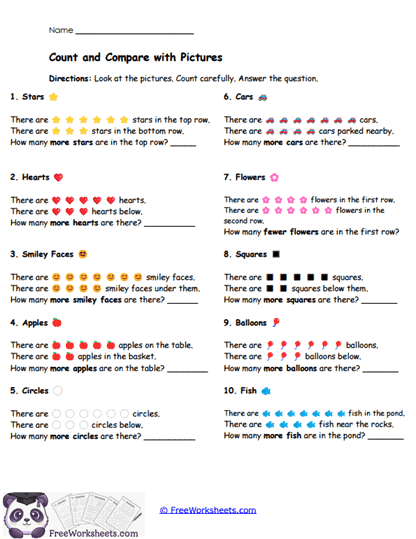
This worksheet is a visual counting and comparison activity designed to strengthen early subtraction skills within 10. Students analyze two picture groups and determine how many more items appear in one set than the other. It supports kindergarten and first grade learners who are developing number sense and comparison reasoning. The activity emphasizes accurate counting before calculating the difference. For example, 7 stars and 5 stars becomes 7 − 5 = 2. By connecting visual models to equations, students deepen their understanding of subtraction as finding the difference between quantities.
Curriculum and Grade Alignment
The worksheet aligns with foundational counting and operations standards for early elementary math. Its primary goal is to reinforce one-to-one correspondence while introducing comparison-based subtraction within 10. Students should already demonstrate the ability to count objects accurately and recognize numerals up to 10. This activity supports Common Core Standards K.CC.B.4 and K.OA.A.1 by connecting counting to subtraction problem solving. It also aligns with TEKS K.2(D) and K.3(H), which focus on comparing sets and determining differences. The worksheet builds a bridge from concrete counting experiences to symbolic mathematical representation.
Student Tasks
On this worksheet, students will carefully count objects in two rows or picture groups such as stars, hearts, apples, and balloons. They compare totals and determine which group has more items. After identifying the larger set, students calculate how many more items are present. Each response requires writing the correct difference in the blank provided. Learners must rely on accurate counting before performing subtraction. The tasks reinforce visual discrimination and comparison vocabulary simultaneously.
Common Challenges and Misconceptions
Students may miscount when images are spaced closely together or arranged irregularly. Some learners rush to subtract without verifying their counting totals first. Others may misunderstand the question and subtract in the incorrect order. Young students sometimes rely on visual estimation rather than precise counting. Additionally, confusion between “more” and “fewer” can impact accuracy. Teachers can encourage students to point to each object while counting and double-check totals before solving.
Implementation Guidance
This worksheet works well as part of a math centers rotation focused on counting and comparing quantities. Teachers can use it during small-group instruction to provide targeted support with subtraction within 10. It also serves as an effective formative assessment after lessons on comparison language. Parents and homeschool educators may incorporate it into daily math review sessions. Pairing the worksheet with physical counters reinforces conceptual understanding. Guided practice before independent completion helps ensure success.
Details and Features
The worksheet features engaging picture sets that make early subtraction practice visually accessible. Each problem includes ample space for students to record their answers clearly. The clean layout supports young learners who benefit from minimal distractions. Visual groupings are clearly separated to assist accurate counting. The black-and-white format ensures easy printing for classroom or home use. Its consistent structure makes it simple to implement across multiple learning environments.