
About This Worksheet
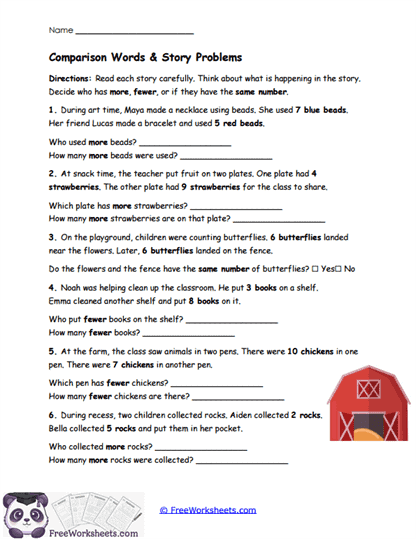
This worksheet is a narrative-based subtraction activity focused on solving comparison word problems within 10. Students read short math stories and determine how many more or fewer items one group has than another. Designed for first grade learners, it integrates reading comprehension with early operations and algebraic thinking. The activity emphasizes careful interpretation of comparison vocabulary before performing subtraction. For example, 10 chickens and 7 chickens becomes 10 − 7 = 3. By translating written scenarios into subtraction equations, students strengthen their understanding of difference as a mathematical concept.
Curriculum and Grade Alignment
This resource aligns with first grade standards focused on solving addition and subtraction word problems within 10. The primary learning goal is to develop fluency in identifying comparison relationships and representing them symbolically. Students should already demonstrate basic subtraction fact knowledge and the ability to read simple sentences independently. The worksheet supports Common Core Standard 1.OA.A.1, which requires solving word problems involving addition and subtraction within 20, with a developmental focus here on within 10. It also aligns with TEKS 1.3(B), which addresses comparing quantities and determining differences. This activity builds readiness for multi-step word problems in later grades.
Student Tasks
On this worksheet, students will read short story problems describing two groups of objects or characters. They must identify which group has more or fewer items based on the information provided. Students calculate the difference between the quantities using subtraction within 10. Some prompts may require recognizing when two groups have the same number of items. Learners record their answers clearly in the designated response area. The tasks require careful reading, reasoning, and accurate computation.
Common Challenges and Misconceptions
Students may overlook key numerical details embedded within the story text. Some learners might misinterpret comparison words such as “more than” or “fewer than.” Others may subtract incorrectly due to placing numbers in the wrong order. Confusion may arise when stories present quantities in separate sentences rather than side by side. Rushing through reading can also lead to avoidable errors. Teachers can model highlighting important numbers and restating the problem in their own words before solving.
Implementation Guidance
Teachers can incorporate this worksheet into lessons that emphasize solving comparison word problems through close reading. It works well during guided math instruction or as independent practice after modeling subtraction strategies. Small-group discussion allows students to explain their thinking and clarify misunderstandings. Parents and homeschool educators may use this worksheet to reinforce subtraction fluency and comprehension skills simultaneously. Reviewing one example problem together before independent work increases confidence. This worksheet also serves as an effective formative assessment for subtraction reasoning within 10.
Details and Features
The worksheet features clearly written, developmentally appropriate math stories. Each problem includes sufficient space for students to record answers neatly. The layout promotes readability and minimizes distractions for early learners. Problem structures vary slightly to encourage flexible thinking. The black-and-white printable format supports easy classroom copying. Its straightforward design makes it suitable for both classroom and home instruction.